
Join Our JEE Preparation Group
Prep with like-minded aspirants; Get access to free daily tests and study material.
Sign in
Please select an account to continue using cracku.in
↓ →
Join Our JEE Preparation Group
Prep with like-minded aspirants; Get access to free daily tests and study material.
Match List I with List II
| List I (molecules/ions) | List II (No. of lone pairs of e$$^-$$ on central atom) |
|---|---|
| (A) IF$$_7$$ | I. Three |
| (B) ICl$$_4^-$$ | II. One |
| (C) XeF$$_6$$ | III. Two |
| (D) XeF$$_2$$ | IV. Zero |
Choose the correct answer from the options given below:
We need to match each molecule/ion with the number of lone pairs on its central atom.
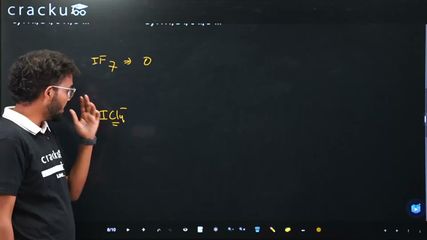
(A) IF$$_7$$:
Iodine has 7 valence electrons. It forms 7 bonds with 7 fluorine atoms, using all its valence electrons for bonding. The hybridization is $$sp^3d^3$$.
Lone pairs on I = $$\frac{7 - 7}{2} = 0$$ (Zero) --> matches IV
(B) ICl$$_4^-$$:
Iodine has 7 valence electrons, plus 1 from the negative charge = 8 electrons available. It forms 4 bonds with Cl atoms, leaving 4 non-bonding electrons.
Lone pairs on I = $$\frac{8 - 4}{2} = 2$$ (Two) --> matches III
The geometry is square planar ($$sp^3d^2$$, with 2 lone pairs in axial positions of the octahedron).
(C) XeF$$_6$$:
Xenon has 8 valence electrons. It forms 6 bonds with F atoms, leaving 2 non-bonding electrons.
Lone pairs on Xe = $$\frac{8 - 6}{2} = 1$$ (One) --> matches II
The geometry is distorted octahedral ($$sp^3d^3$$ hybridization with 1 lone pair).
(D) XeF$$_2$$:
Xenon has 8 valence electrons. It forms 2 bonds with F atoms, leaving 6 non-bonding electrons.
Lone pairs on Xe = $$\frac{8 - 2}{2} = 3$$ (Three) --> matches I
The geometry is linear ($$sp^3d$$ hybridization with 3 lone pairs in equatorial positions of a trigonal bipyramid).
The correct matching is: A-IV, B-III, C-II, D-I.
The correct answer is Option 2.
Was this solution helpful?
Click on the Email ☝️ to Watch the Video Solution
Create a FREE account and get:
_1.webp)

Educational materials for JEE preparation

Ask our AI anything

AI can make mistakes. Please verify important information.
AI can make mistakes. Please verify important information.


