
Join Our JEE Preparation Group
Prep with like-minded aspirants; Get access to free daily tests and study material.
Sign in
Please select an account to continue using cracku.in
↓ →
Join Our JEE Preparation Group
Prep with like-minded aspirants; Get access to free daily tests and study material.
We need to identify the pair where both compounds form polar molecular solids.
We start by noting that
Polar molecular solids are composed of polar molecules held together by dipole-dipole interactions (and possibly hydrogen bonds). The key requirement is that each molecule must have a net non-zero dipole moment.
Next,
Option 1: SO$$_2$$(s), CO$$_2$$(s)
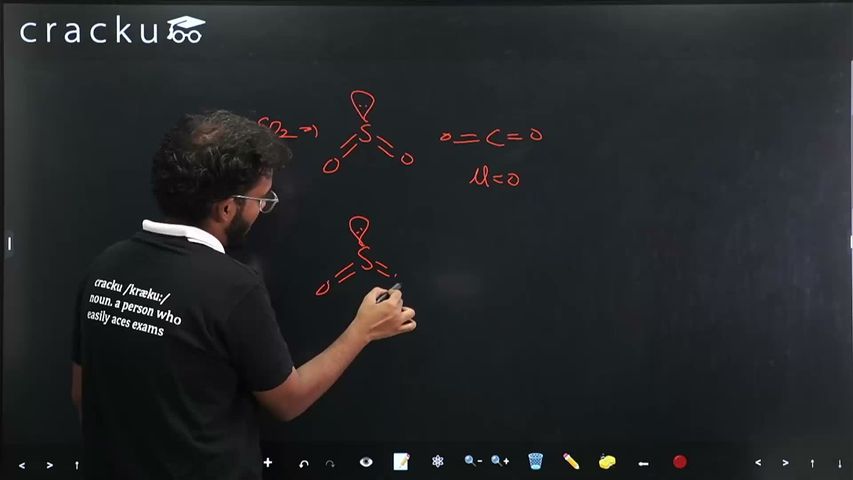
SO$$_2$$ is bent (bond angle ~119 degrees) with a net dipole moment -- it is polar. However, CO$$_2$$ is linear and symmetric, so its two C=O bond dipoles cancel, giving zero net dipole moment. CO$$_2$$ forms a non-polar molecular solid. This pair does not work.
Option 2: SO$$_2$$(s), NH$$_3$$(s)
SO$$_2$$ is polar (bent structure, as explained above). NH$$_3$$ has a pyramidal geometry with a lone pair on nitrogen, giving a net dipole moment of 1.47 D. Both are polar molecules, and both form polar molecular solids. This is the correct pair.
Option 3: MgO(s), SO$$_2$$(s)
MgO is an ionic solid (Mg$$^{2+}$$ and O$$^{2-}$$ ions), not a molecular solid. This pair does not work.
Option 4: HCl(s), AlN(s)
HCl is a polar molecule, but AlN is a covalent network solid (similar to diamond/BN structure), not a molecular solid. This pair does not work.
The correct answer is Option 2: SO$$_2$$(s), NH$$_3$$(s).
Was this solution helpful?
Click on the Email ☝️ to Watch the Video Solution
Create a FREE account and get:
_1.webp)

Educational materials for JEE preparation

Ask our AI anything

AI can make mistakes. Please verify important information.
AI can make mistakes. Please verify important information.


