
Join Our JEE Preparation Group
Prep with like-minded aspirants; Get access to free daily tests and study material.
Sign in
Please select an account to continue using cracku.in
↓ →
Join Our JEE Preparation Group
Prep with like-minded aspirants; Get access to free daily tests and study material.
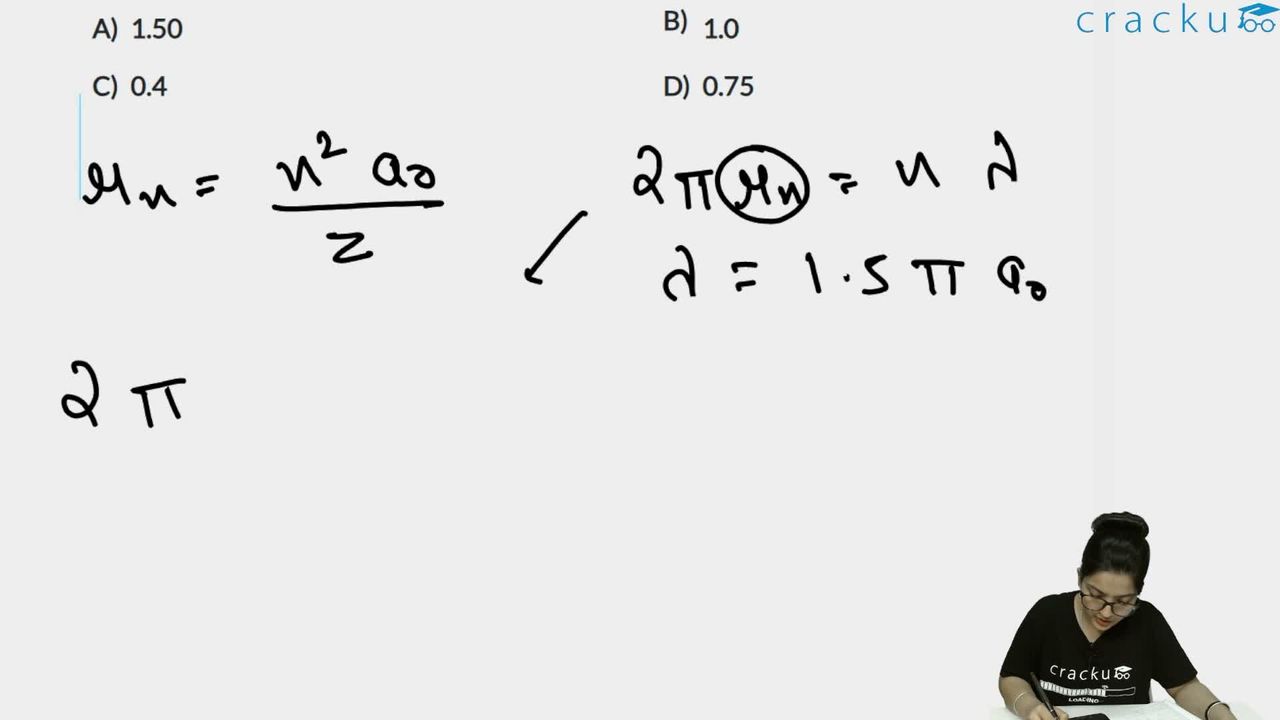
If the de Broglie wavelength of the electron in $$n^{th}$$ Bohr orbit in a hydrogenic atom is equal to $$1.5\pi a_0$$ ($$a_0$$ is Bohr radius), then the value of $$\frac{n}{z}$$ is:
We begin by recalling the two standard Bohr‐model relations for a hydrogenic (one-electron) atom with nuclear charge $$Z$$.
First, the radius of the $$n^{\text{th}}$$ orbit is given by the well-known formula
$$r_n \;=\; \dfrac{n^{2}a_0}{Z},$$
where $$a_0$$ is the Bohr radius for the hydrogen atom.
Second, de Broglie’s standing-wave condition states that an integral number of wavelengths must fit exactly into the circumference of the circular orbit. Mathematically,
$$2\pi r_n \;=\; n\lambda,$$
where $$\lambda$$ is the de Broglie wavelength of the electron in that orbit.
We are told that this wavelength has the numerical value
$$\lambda \;=\; 1.5\pi a_0 \;=\; \dfrac{3}{2}\pi a_0.$$
Our task is to find the ratio $$\dfrac{n}{Z}$$.
From the standing-wave condition we first isolate $$\lambda$$:
$$\lambda \;=\; \dfrac{2\pi r_n}{n}.$$
Now we substitute the explicit expression for $$r_n$$ from the radius formula:
$$\lambda \;=\; \dfrac{2\pi}{n}\,\Bigl(\dfrac{n^{2}a_0}{Z}\Bigr) \;=\; 2\pi\,\dfrac{n a_0}{Z}.$$
This theoretical value of $$\lambda$$ must equal the given value. Hence we set
$$2\pi\,\dfrac{n a_0}{Z} \;=\; \dfrac{3}{2}\pi a_0.$$
We can now simplify step by step. First cancel the common factors $$\pi$$ and $$a_0$$ on both sides:
$$2\,\dfrac{n}{Z} \;=\; \dfrac{3}{2}.$$
Multiplying both sides by $$Z$$ and, simultaneously, by $$2$$ to clear the fraction, we have
$$4n \;=\; 3Z.$$
Finally, dividing both sides by $$4Z$$ gives the desired ratio:
$$\dfrac{n}{Z} \;=\; \dfrac{3}{4} \;=\; 0.75.$$
Hence, the correct answer is Option 4.
Was this solution helpful?
Click on the Email ☝️ to Watch the Video Solution
Create a FREE account and get:
_1.webp)

Educational materials for JEE preparation

Ask our AI anything

AI can make mistakes. Please verify important information.
AI can make mistakes. Please verify important information.


