
Join Our JEE Preparation Group
Prep with like-minded aspirants; Get access to free daily tests and study material.
Sign in
Please select an account to continue using cracku.in
↓ →
Join Our JEE Preparation Group
Prep with like-minded aspirants; Get access to free daily tests and study material.
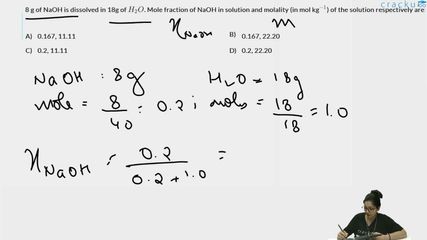
8 g of NaOH is dissolved in 18g of $$H_2O$$. Mole fraction of NaOH in solution and molality (in mol kg$$^{-1}$$) of the solution respectively are:
First, we calculate the number of moles of the solute, sodium hydroxide. The molar mass of $$\text{NaOH}$$ is obtained by adding the atomic masses of its constituent elements: $$\text{Na}\,(23\ \text{g mol}^{-1}) + \text{O}\,(16\ \text{g mol}^{-1}) + \text{H}\,(1\ \text{g mol}^{-1}) = 40\ \text{g mol}^{-1}$$. The sample contains $$8\ \text{g}$$ of $$\text{NaOH}$$, so
$$n_{\text{NaOH}} = \frac{\text{mass}}{\text{molar mass}} = \frac{8\ \text{g}}{40\ \text{g mol}^{-1}} = 0.2\ \text{mol}.$$
Next, we consider the solvent, water. Its molar mass is $$18\ \text{g mol}^{-1}$$. The mass of water given is $$18\ \text{g}$$, therefore
$$n_{\text{H}_2\text{O}} = \frac{18\ \text{g}}{18\ \text{g mol}^{-1}} = 1.0\ \text{mol}.$$
The mole fraction of solute (NaOH) is defined by the formula $$\chi_{\text{NaOH}} = \frac{n_{\text{NaOH}}}{n_{\text{NaOH}} + n_{\text{H}_2\text{O}}}.$$ Substituting the two mole values, we obtain
$$\chi_{\text{NaOH}} = \frac{0.2}{0.2 + 1.0} = \frac{0.2}{1.2} = 0.1666\ldots \approx 0.167.$$
Now, molality (denoted by $$m$$) is given by the relation $$m = \frac{n_{\text{solute}}}{\text{mass of solvent in kg}}.$$ Here, the solvent mass is $$18\ \text{g} = 0.018\ \text{kg}$$. Hence
$$m = \frac{0.2\ \text{mol}}{0.018\ \text{kg}} = 11.11\ \text{mol kg}^{-1}.$$
So, the mole fraction of NaOH in the solution is $$0.167$$ and the molality is $$11.11\ \text{mol kg}^{-1}$$.
Hence, the correct answer is Option A.
Was this solution helpful?
Click on the Email ☝️ to Watch the Video Solution
Create a FREE account and get:
_1.webp)

Educational materials for JEE preparation

Ask our AI anything

AI can make mistakes. Please verify important information.
AI can make mistakes. Please verify important information.


