
Join Our JEE Preparation Group
Prep with like-minded aspirants; Get access to free daily tests and study material.
Sign in
Please select an account to continue using cracku.in
↓ →
Join Our JEE Preparation Group
Prep with like-minded aspirants; Get access to free daily tests and study material.
Four identical thin, square metal sheets, $$S_1$$, $$S_2$$, $$S_3$$, and $$S_4$$, each of side $$a$$ are kept parallel to each other with equal distance $$d$$ ($$\ll a$$) between them, as shown in the figure. Let $$C_0 = \varepsilon_0 a^2/d$$, where $$\varepsilon_0$$ is the permittivity of free space.
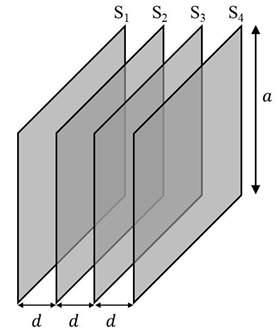
Match the quantities mentioned in List-I with their values in List-II and choose the correct option.
| List-I | List-II | ||
|---|---|---|---|
| (P) | The capacitance between $$S_1$$ and $$S_4$$, with $$S_2$$ and $$S_3$$ not connected, is | (1) | $$3C_0$$ |
| (Q) | The capacitance between $$S_1$$ and $$S_4$$, with $$S_2$$ shorted to $$S_3$$, is | (2) | $$C_0/2$$ |
| (R) | The capacitance between $$S_1$$ and $$S_3$$, with $$S_2$$ shorted to $$S_4$$, is | (3) | $$C_0/3$$ |
| (S) | The capacitance between $$S_1$$ and $$S_2$$, with $$S_3$$ shorted to $$S_1$$, and $$S_2$$ shorted to $$S_4$$, is | (4) | $$2C_0/3$$ |
| (5) | $$2C_0$$ |
The four metal sheets $$S_1,S_2,S_3,S_4$$ are identical squares of area $$A=a^{2}$$ kept successively at equal separations $$d\,(d\ll a)$$.
Between any two adjacent sheets the capacitance is
$$C_0=\frac{\varepsilon_0A}{d}\quad -(1)$$
Thus the stack contains three individual capacitors:
$$S_1\!-\!S_2: C_{12}=C_0,\; S_2\!-\!S_3: C_{23}=C_0,\; S_3\!-\!S_4: C_{34}=C_0$$.
Required: capacitance between $$S_1$$ and $$S_4$$ with $$S_2,S_3$$ left isolated (not connected).
The three capacitors are then in series:
$$\frac{1}{C_{\text{eq}}}= \frac{1}{C_{12}}+\frac{1}{C_{23}}+\frac{1}{C_{34}} =\frac{1}{C_0}+\frac{1}{C_0}+\frac{1}{C_0}= \frac{3}{C_0}$$
$$\Rightarrow\; C_{\text{eq}}=\frac{C_0}{3}$$
So (P) corresponds to value $$\mathbf{C_0/3}$$, i.e. List-II (3).
Case Q:Required: capacitance between $$S_1$$ and $$S_4$$ with $$S_2$$ shorted to $$S_3$$ (equipotential).
Because $$S_2$$ and $$S_3$$ form one common conductor, the region between them is at a single potential and contributes no electric field. The stack now looks like two capacitors in series:
$$S_1\;{\large\|}\;[S_2\!+\!S_3]\;{\large\|}\;S_4$$
Each of the two gaps still has capacitance $$C_0$$, hence
$$C_{\text{eq}}=\frac{C_0 \times C_0}{C_0+C_0}= \frac{C_0}{2}$$
Thus (Q) gives $$\mathbf{C_0/2}$$, that is List-II (2).
Case R:Required: capacitance between $$S_1$$ and $$S_3$$ when $$S_2$$ is shorted to $$S_4$$.
Define the three electrical nodes:
Node A: $$S_1$$ (one terminal)
Node B: $$S_3$$ (other terminal)
Node C: $$S_2$$ shorted to $$S_4$$ (floating internal conductor)
Network of capacitors:
$$S_1\!\!-\!\!S_2 : C_{AC}=C_0,\quad S_2\!\!-\!\!S_3 : C_{CB}=C_0,\quad S_3\!\!-\!\!S_4 : C_{CB}'=C_0$$
Capacitances between the same pair of nodes add, so between nodes B and C we have
$$C_{BC}=C_{CB}+C_{CB}'=2C_0$$
Now A-C and C-B are in series. The equivalent between A and B is therefore
$$C_{\text{eq}}=\frac{C_{AC}\,C_{BC}}{C_{AC}+C_{BC}} =\frac{C_0\,(2C_0)}{C_0+2C_0} =\frac{2C_0}{3}$$
Hence (R) gives $$\mathbf{2C_0/3}$$, i.e. List-II (4).
Case S:Required: capacitance between $$S_1$$ and $$S_2$$ when $$S_3$$ is shorted to $$S_1$$ and $$S_2$$ is shorted to $$S_4$$.
Thus we have two final nodes:
Node A: $$S_1$$ and $$S_3$$ (same potential)
Node B: $$S_2$$ and $$S_4$$ (same potential)
All three original capacitors now connect directly between these two nodes:
$$C_{12}=C_0,\; C_{23}=C_0,\; C_{34}=C_0$$
They are in parallel, so
$$C_{\text{eq}}=C_{12}+C_{23}+C_{34}=3C_0$$
Therefore (S) corresponds to $$\mathbf{3C_0}$$, which is List-II (1).
Collecting the four matches:
P → 3, Q → 2, R → 4, S → 1
The option that lists this combination is Option C.
Create a FREE account and get:
_1.webp)

Educational materials for JEE preparation

Ask our AI anything

AI can make mistakes. Please verify important information.
AI can make mistakes. Please verify important information.


