
Join Our JEE Preparation Group
Prep with like-minded aspirants; Get access to free daily tests and study material.
Sign in
Please select an account to continue using cracku.in
↓ →
Join Our JEE Preparation Group
Prep with like-minded aspirants; Get access to free daily tests and study material.
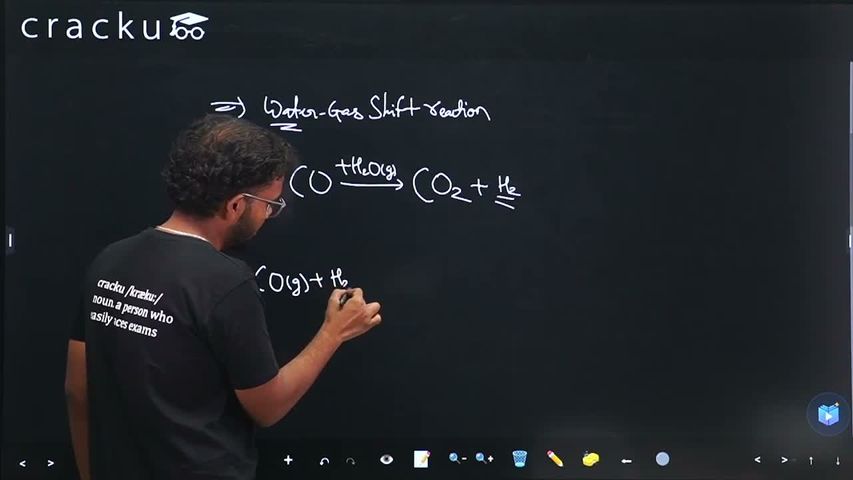
The equation that represents the water-gas shift reaction is:
First, we recall the definition of the water-gas shift reaction. In industrial chemistry this name is reserved for the reversible catalytic conversion in which carbon monoxide reacts with steam to give carbon dioxide and hydrogen. Symbolically we write
$$\text{CO}(g) + \text{H}_2\text{O}(g) \;\rightleftharpoons\; \text{CO}_2(g) + \text{H}_2(g).$$
The standard operating temperature for the high-temperature stage of this process is about $$673\;\text{K}$$, and it is always carried out in the presence of a suitable catalyst such as iron oxide promoted with chromium oxide. Thus, any correct option must explicitly contain (i) carbon monoxide on the reactant side, (ii) steam on the reactant side, (iii) carbon dioxide and hydrogen on the product side, and (iv) a temperature near $$673\;\text{K}$$ along with a catalyst mention.
Now we examine the four alternatives one by one.
Option A gives $$\text{CH}_4(g) + \text{H}_2\text{O}(g) \xrightarrow{1270\,\text{K}} \text{CO}(g) + 3\text{H}_2(g).$$ This is the steam-reforming reaction of methane, not the water-gas shift. The reactants and products do not match the required $$\text{CO}/\text{H}_2\text{O}$$ ⇌ $$\text{CO}_2/\text{H}_2$$ pattern.
Option B gives $$2\text{C}(s) + \text{O}_2(g) + 4\text{N}_2(g) \xrightarrow{1273\,\text{K}} 2\text{CO}(g) + 4\text{N}_2(g).$$ This merely represents the combustion of carbon in air to carbon monoxide; it again fails to involve steam and therefore cannot be the water-gas shift reaction.
Option C gives $$\text{C}(s) + \text{H}_2\text{O}(g) \xrightarrow{1270\,\text{K}} \text{CO}(g) + \text{H}_2(g).$$ Although steam is present, the solid carbon reactant shows that this is the water-gas (or carbon-steam) reaction, not the shift reaction. The essential carbon dioxide product is missing, so this option is also ruled out.
Option D gives $$\text{CO}(g) + \text{H}_2\text{O}(g) \xrightarrow{673\,\text{K}}_{\text{catalyst}} \text{CO}_2(g) + \text{H}_2(g).$$ Here every required feature is present: carbon monoxide and steam on the left, carbon dioxide and hydrogen on the right, a temperature around $$673\;\text{K}$$, and an explicit mention of a catalyst. Therefore this reaction exactly matches the definition of the water-gas shift reaction.
All other options fail to satisfy one or more of these essential criteria, so they must be rejected.
Hence, the correct answer is Option D.
Was this solution helpful?
Click on the Email ☝️ to Watch the Video Solution
Create a FREE account and get:
_1.webp)

Educational materials for JEE preparation

Ask our AI anything

AI can make mistakes. Please verify important information.
AI can make mistakes. Please verify important information.


