
Join Our JEE Preparation Group
Prep with like-minded aspirants; Get access to free daily tests and study material.
Sign in
Please select an account to continue using cracku.in
↓ →
Join Our JEE Preparation Group
Prep with like-minded aspirants; Get access to free daily tests and study material.
Consider the following reaction:
$$\text{N}_2\text{O}_4(g) = 2\text{NO}_2(g);\;\Delta H^0 = +58\,\text{k}$$
For each of the following cases (a, b), the direction in which the equilibrium shifts is:
(a) Temperature is decreased.
(b) Pressure is increased by adding $$\text{N}_2$$ at constant T.
To determine how the equilibrium position shifts in the reaction
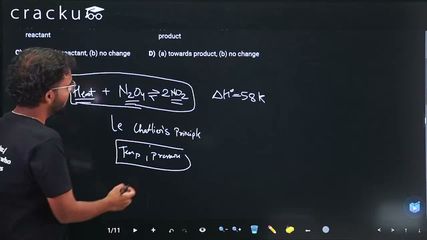
$$N_2O_4(g) \rightleftharpoons 2NO_2(g), \qquad \Delta H^\circ = +58\ \text{kJ mol}^{-1},$$
we apply Le Chatelier's Principle, which states that when a system at equilibrium is subjected to a change in concentration, temperature, or pressure, the equilibrium shifts in a direction that opposes the imposed change.
Since $$\Delta H^\circ$$ is positive, the forward reaction is endothermic and may be represented as
$$\text{Heat} + N_2O_4(g) \rightleftharpoons 2NO_2(g).$$
When the temperature is decreased, the system tends to produce heat to oppose the change. Therefore, the equilibrium shifts in the reverse (exothermic) direction, favouring the formation of $$N_2O_4$$. Hence, the equilibrium shifts towards the reactant side.
When the pressure is increased by adding $$N_2$$ (an inert gas) at constant temperature, the partial pressures of $$N_2O_4$$ and $$NO_2$$ remain unchanged. Since the equilibrium expression depends only on the reacting species, the equilibrium position is not affected, and no shift occurs.
Hence,
Therefore, the correct answer is (a) towards reactant, (b) no change.
Was this solution helpful?
Click on the Email ☝️ to Watch the Video Solution
Create a FREE account and get:
_1.webp)

Educational materials for JEE preparation

Ask our AI anything

AI can make mistakes. Please verify important information.
AI can make mistakes. Please verify important information.


