
Join Our JEE Preparation Group
Prep with like-minded aspirants; Get access to free daily tests and study material.
Sign in
Please select an account to continue using cracku.in
↓ →
Join Our JEE Preparation Group
Prep with like-minded aspirants; Get access to free daily tests and study material.
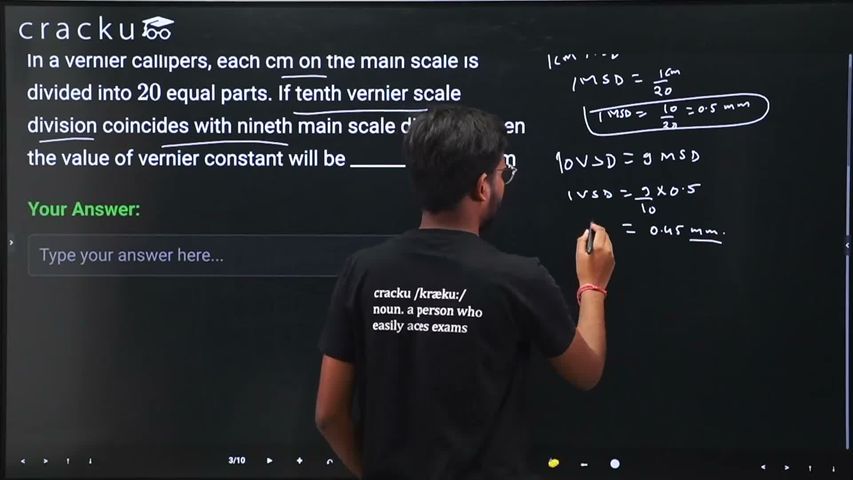
In a vernier callipers, each cm on the main scale is divided into $$20$$ equal parts. If tenth vernier scale division coincides with nineth main scale division. Then the value of vernier constant will be ______ $$\times 10^{-2}$$ mm
Correct Answer: 5
We need to find the vernier constant of a vernier callipers where each cm on the main scale is divided into 20 equal parts, and the 10th vernier scale division coincides with the 9th main scale division.
First, the value of one Main Scale Division (MSD) is determined by dividing 1 cm into 20 equal parts:
$$1 \text{ MSD} = \frac{1 \text{ cm}}{20} = \frac{10 \text{ mm}}{20} = 0.5 \text{ mm}$$
Next, since 10 vernier scale divisions coincide with 9 main scale divisions, the value of one Vernier Scale Division (VSD) is
$$1 \text{ VSD} = \frac{9}{10} \times 1 \text{ MSD} = \frac{9}{10} \times 0.5 = 0.45 \text{ mm}$$
The vernier constant (also called the least count) is the difference between one MSD and one VSD:
$$\text{VC} = 1 \text{ MSD} - 1 \text{ VSD}$$
$$\text{VC} = 0.5 - 0.45 = 0.05 \text{ mm}$$
Expressing this value in the required form gives
$$\text{VC} = 0.05 \text{ mm} = 5 \times 10^{-2} \text{ mm}$$
Therefore, the value of the vernier constant is 5 $$\times 10^{-2}$$ mm.
Was this solution helpful?
Click on the Email ☝️ to Watch the Video Solution
Create a FREE account and get:
_1.webp)

Educational materials for JEE preparation

Ask our AI anything

AI can make mistakes. Please verify important information.
AI can make mistakes. Please verify important information.
