
Join Our JEE Preparation Group
Prep with like-minded aspirants; Get access to free daily tests and study material.
Sign in
Please select an account to continue using cracku.in
↓ →
Join Our JEE Preparation Group
Prep with like-minded aspirants; Get access to free daily tests and study material.
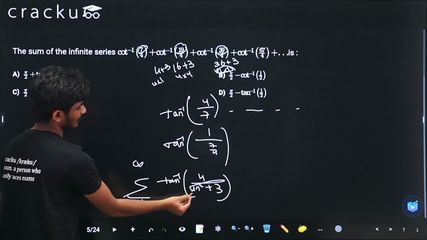
The sum of the infinite series $$\cot^{-1}\left(\frac{7}{4}\right) + \cot^{-1}\left(\frac{19}{4}\right) + \cot^{-1}\left(\frac{39}{4}\right) + \cot^{-1}\left(\frac{67}{4}\right) + \ldots$$ is :
The series is
$$S=\cot^{-1}\!\left(\frac{7}{4}\right)+\cot^{-1}\!\left(\frac{19}{4}\right)+ \cot^{-1}\!\left(\frac{39}{4}\right)+\cot^{-1}\!\left(\frac{67}{4}\right)+\ldots$$
Step 1: Write the general term
The numerators form the sequence 7, 19, 39, 67, …
Differences: $$19-7=12,\;39-19=20,\;67-39=28,\ldots$$
These differences themselves form an A.P. with common difference 8.
If $$k_n$$ is the nth numerator, then
$$k_{n+1}=k_n+8n+4,\;k_1=7$$
Summing this recurrence gives
$$k_n=7+\sum_{m=1}^{\,n-1}(8m+4)=7+4(n-1)n+4(n-1)=4n^{2}+3$$
Hence the nth term of the series is $$T_n=\cot^{-1}\!\left(\frac{4n^{2}+3}{4}\right)\qquad n=1,2,3,\ldots$$
Step 2: Convert $$\cot^{-1}$$ to $$\tan^{-1}$$
For positive arguments, $$\cot^{-1}x=\tan^{-1}\!\left(\frac1x\right)$$.
Therefore
$$T_n=\tan^{-1}\!\left(\frac{4}{4n^{2}+3}\right)$$
Step 3: Express each term as a difference of two $$\tan^{-1}$$
Recall the identity
$$\tan^{-1}A-\tan^{-1}B=\tan^{-1}\!\left(\frac{A-B}{1+AB}\right).$$
Choose
$$A=\frac{2n+1}{2},\qquad B=\frac{2n-1}{2}.$$
Then
$$A-B=\frac{2n+1-(2n-1)}{2}=1,$$
$$1+AB=1+\frac{(2n+1)(2n-1)}{4}=1+\frac{4n^{2}-1}{4}=\frac{4n^{2}+3}{4}.$$
Hence
$$\tan^{-1}A-\tan^{-1}B=\tan^{-1}\!\left(\frac{1}{(4n^{2}+3)/4}\right) =\tan^{-1}\!\left(\frac{4}{4n^{2}+3}\right)=T_n.$$
Thus
$$T_n=\tan^{-1}\!\left(\frac{2n+1}{2}\right)-\tan^{-1}\!\left(\frac{2n-1}{2}\right).$$
Step 4: Form the partial sum and telescope
Write the first N terms:
$$S_N=\sum_{n=1}^{N}T_n =\bigl[\tan^{-1}\!\left(\tfrac32\right)-\tan^{-1}\!\left(\tfrac12\right)\bigr] +\bigl[\tan^{-1}\!\left(\tfrac52\right)-\tan^{-1}\!\left(\tfrac32\right)\bigr] +\ldots +\bigl[\tan^{-1}\!\left(\tfrac{2N+1}{2}\right)-\tan^{-1}\!\left(\tfrac{2N-1}{2}\right)\bigr].$$
All intermediate terms cancel, leaving
$$S_N=\tan^{-1}\!\left(\frac{2N+1}{2}\right)-\tan^{-1}\!\left(\frac12\right).$$
Step 5: Take the limit as $$N\rightarrow\infty$$
$$\lim_{N\to\infty}\tan^{-1}\!\left(\frac{2N+1}{2}\right)=\tan^{-1}(\infty)=\frac{\pi}{2}.$$
Therefore
$$S=\lim_{N\to\infty}S_N=\frac{\pi}{2}-\tan^{-1}\!\left(\frac12\right).$$
Step 6: Match with the given options
Option D is $$\frac{\pi}{2}-\tan^{-1}\!\left(\frac12\right),$$ which equals the obtained sum.
Hence the required sum is $$\boxed{\frac{\pi}{2}-\tan^{-1}\!\left(\dfrac12\right)}$$, i.e. Option D.
Click on the Email ☝️ to Watch the Video Solution
Create a FREE account and get:
_1.webp)

Educational materials for JEE preparation

Ask our AI anything

AI can make mistakes. Please verify important information.
AI can make mistakes. Please verify important information.


