
Join Our JEE Preparation Group
Prep with like-minded aspirants; Get access to free daily tests and study material.
Sign in
Please select an account to continue using cracku.in
↓ →
Join Our JEE Preparation Group
Prep with like-minded aspirants; Get access to free daily tests and study material.
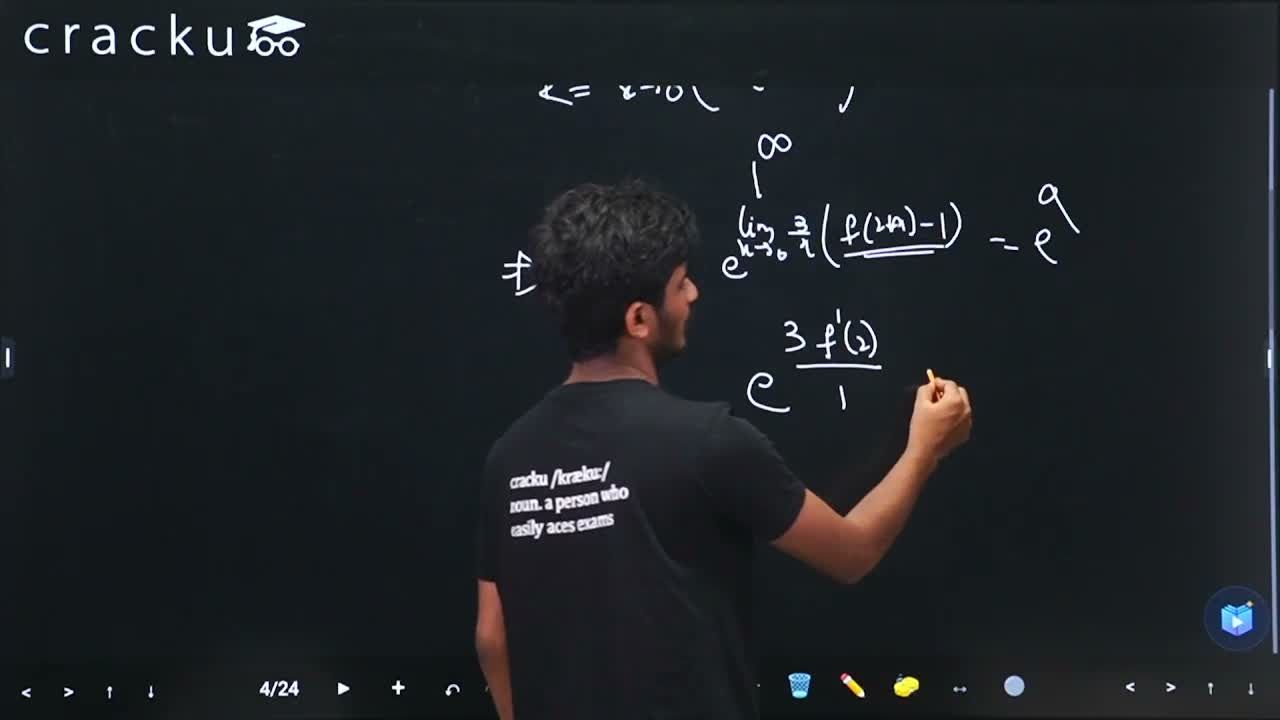
Let f be a differentiable function on $$\mathbf{R}$$ such that $$f(2) = 1$$, $$f'(2) = 4$$. Let $$\lim_{x \to 0} (f(2+x))^{3/x} = e^\alpha$$. Then the number of times the curve $$y = 4x^3 - 4x^2 - 4(\alpha - 7)x - \alpha$$ meets the x-axis is :
Let us first evaluate $$\alpha$$ from the given limit
$$\lim_{x\to 0}\,(f(2+x))^{3/x}=e^{\alpha}$$
Take natural logarithm of the expression inside the limit:
$$\ln\left[(f(2+x))^{3/x}\right]=\frac{3}{x}\,\ln\bigl(f(2+x)\bigr).$$
Because $$f$$ is differentiable at $$2$$, use the linear (Taylor) expansion
$$f(2+x)=f(2)+f'(2)\,x+o(x)=1+4x+o(x).$$
Write $$\ln\bigl(f(2+x)\bigr)=\ln\!\left(1+4x+o(x)\right).$$
For small $$h$$, $$\ln(1+h)=h+o(h)$$, so
$$\ln\bigl(f(2+x)\bigr)=4x+o(x).$$
Therefore
$$\ln\left[(f(2+x))^{3/x}\right]=\frac{3}{x}\,\bigl(4x+o(x)\bigr)=12+o(1).$$
Taking the limit as $$x\to 0$$ gives
$$\lim_{x\to 0}\ln\left[(f(2+x))^{3/x}\right]=12.$$
Hence $$\alpha=12$$ and the required limit indeed equals $$e^{12}$$.
Now substitute $$\alpha=12$$ in the cubic curve
$$y=4x^{3}-4x^{2}-4(\alpha-7)x-\alpha =4x^{3}-4x^{2}-4(12-7)x-12 =4x^{3}-4x^{2}-20x-12.$$
Factor out the common factor $$4$$ (this does not affect the roots):
$$y=4\bigl(x^{3}-x^{2}-5x-3\bigr).$$
To locate the zeros, factor the cubic inside the bracket. Try the integer candidates $$x=\pm1,\pm3$$. Substituting $$x=3$$:
$$3^{3}-3^{2}-5(3)-3=27-9-15-3=0,$$
so $$x-3$$ is a factor. Divide the cubic by $$x-3$$ (synthetic division):
$$x^{3}-x^{2}-5x-3=(x-3)(x^{2}+2x+1).$$
The quadratic factor gives a repeated root
$$x^{2}+2x+1=(x+1)^{2}.$$
Hence
$$x^{3}-x^{2}-5x-3=(x-3)(x+1)^{2}$$ and therefore $$y=4(x-3)(x+1)^{2}.$$
Roots of $$y=0$$ are $$x=3\quad(\text{simple root}),\qquad x=-1\quad(\text{double root}).$$
The curve thus meets the $$x$$-axis at two distinct points: $$x=-1$$ and $$x=3$$.
So, the number of times the curve meets the $$x$$-axis is $$\boxed{2}$$, i.e. Option A.
Was this solution helpful?
Click on the Email ☝️ to Watch the Video Solution
Create a FREE account and get:
_1.webp)

Educational materials for JEE preparation

Ask our AI anything

AI can make mistakes. Please verify important information.
AI can make mistakes. Please verify important information.
