
Join Our JEE Preparation Group
Prep with like-minded aspirants; Get access to free daily tests and study material.
Sign in
Please select an account to continue using cracku.in
↓ →
Join Our JEE Preparation Group
Prep with like-minded aspirants; Get access to free daily tests and study material.
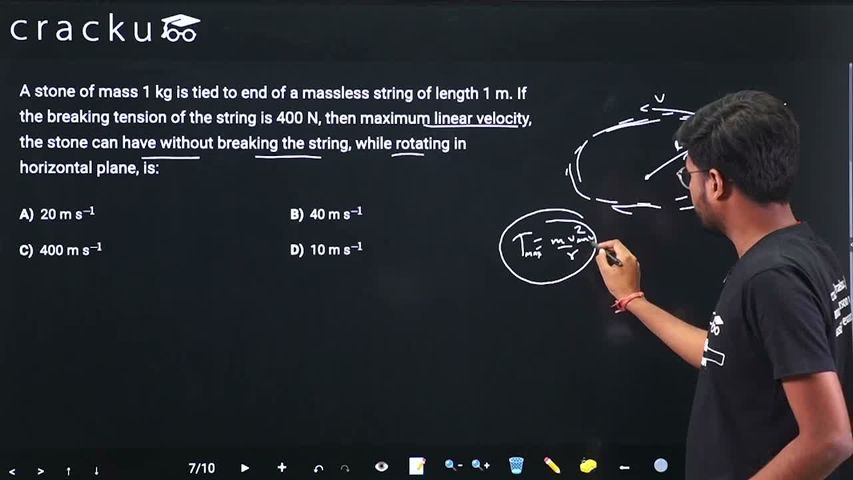
A stone of mass 1 kg is tied to end of a massless string of length 1 m. If the breaking tension of the string is 400 N, then maximum linear velocity, the stone can have without breaking the string, while rotating in horizontal plane, is:
A stone of mass 1 kg tied to a string of length 1 m is rotated in a horizontal plane. The breaking tension is 400 N. We need the maximum linear velocity.
We start by noting that
For circular motion in a horizontal plane, the tension in the string provides the centripetal force needed to keep the stone moving in a circle:
$$ T = \frac{mv^2}{r} $$
where $$m$$ is the mass, $$v$$ is the linear velocity, and $$r$$ is the radius of the circle (equal to the string length).
Next,
The string breaks when $$T > 400$$ N. For the maximum velocity without breaking:
$$ T_{\max} = \frac{mv_{\max}^2}{r} $$
$$ v_{\max} = \sqrt{\frac{T_{\max} \times r}{m}} = \sqrt{\frac{400 \times 1}{1}} = \sqrt{400} = 20\;\text{m/s} $$
The maximum linear velocity is 20 m s$$^{-1}$$.
The correct answer is Option 1: 20 m s$$^{-1}$$.
Click on the Email ☝️ to Watch the Video Solution
Create a FREE account and get:
_1.webp)

Educational materials for JEE preparation

Ask our AI anything

AI can make mistakes. Please verify important information.
AI can make mistakes. Please verify important information.


