
Join Our JEE Preparation Group
Prep with like-minded aspirants; Get access to free daily tests and study material.
Sign in
Please select an account to continue using cracku.in
↓ →
Join Our JEE Preparation Group
Prep with like-minded aspirants; Get access to free daily tests and study material.
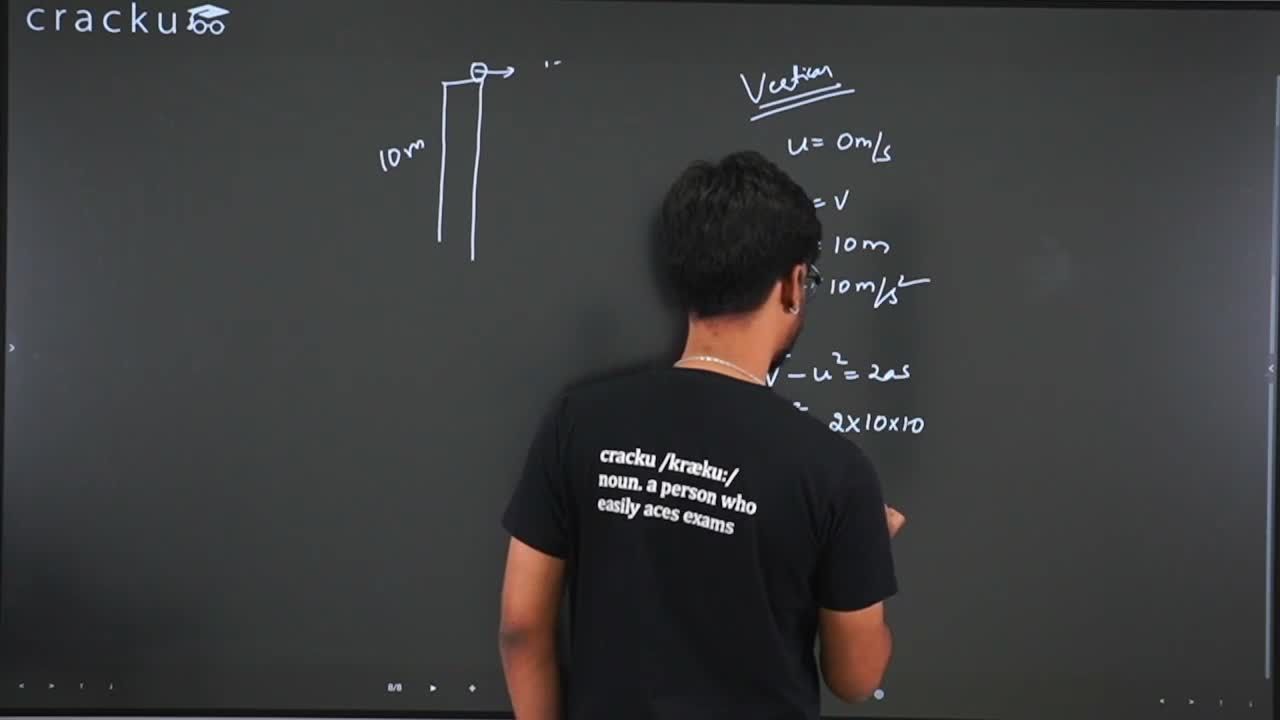
A child stands on the edge of the cliff 10 m above the ground and throws a stone horizontally with an initial speed of $$5 \text{ m s}^{-1}$$. Neglecting the air resistance, the speed with which the stone hits the ground will be ______ $$\text{m s}^{-1}$$ (given, $$g = 10 \text{ m s}^{-2}$$).
The stone has two independent motions after it leaves the child’s hand: horizontal (x-direction) and vertical (y-direction).
Horizontal motion
The horizontal component of velocity remains constant because air resistance is neglected.
Initial horizontal velocity $$u_x = 5 \text{ m s}^{-1}$$.
Therefore, at every instant, $$v_x = 5 \text{ m s}^{-1}$$.
Vertical motion
In the vertical direction the stone is simply in free fall starting from rest (initial vertical velocity $$u_y = 0$$) from a height of $$h = 10 \text{ m}$$.
Using the kinematic equation for displacement in uniformly accelerated motion,
$$h = u_y t + \frac{1}{2} g t^{2} \quad -(1)$$
Substituting $$h = 10 \text{ m}$$, $$u_y = 0$$ and $$g = 10 \text{ m s}^{-2}$$ into $$(1)$$:
$$10 = 0 \cdot t + \frac{1}{2} \times 10 \times t^{2}$$
$$10 = 5 t^{2}$$
$$t^{2} = 2$$
$$t = \sqrt{2} \text{ s}$$
Now, the vertical velocity just before hitting the ground is found from
$$v_y = u_y + g t \quad -(2)$$
With $$u_y = 0$$, $$g = 10 \text{ m s}^{-2}$$, and $$t = \sqrt{2} \text{ s}$$:
$$v_y = 0 + 10 \times \sqrt{2} = 10\sqrt{2} \text{ m s}^{-1}$$
Resultant speed at impact
The horizontal and vertical components combine vectorially. The magnitude of the resultant velocity $$v$$ is
$$v = \sqrt{v_x^{2} + v_y^{2}} \quad -(3)$$
Substituting $$v_x = 5 \text{ m s}^{-1}$$ and $$v_y = 10\sqrt{2} \text{ m s}^{-1}$$ into $$(3)$$:
$$v = \sqrt{(5)^{2} + (10\sqrt{2})^{2}}$$
$$= \sqrt{25 + 200}$$
$$= \sqrt{225}$$
$$= 15 \text{ m s}^{-1}$$
Hence, the stone strikes the ground with a speed of $$15 \text{ m s}^{-1}$$.
Option B is correct.
Was this solution helpful?
Click on the Email ☝️ to Watch the Video Solution
_1.webp)

Educational materials for JEE preparation

Ask our AI anything

AI can make mistakes. Please verify important information.
AI can make mistakes. Please verify important information.