
Join Our JEE Preparation Group
Prep with like-minded aspirants; Get access to free daily tests and study material.
Sign in
Please select an account to continue using cracku.in
↓ →
Join Our JEE Preparation Group
Prep with like-minded aspirants; Get access to free daily tests and study material.
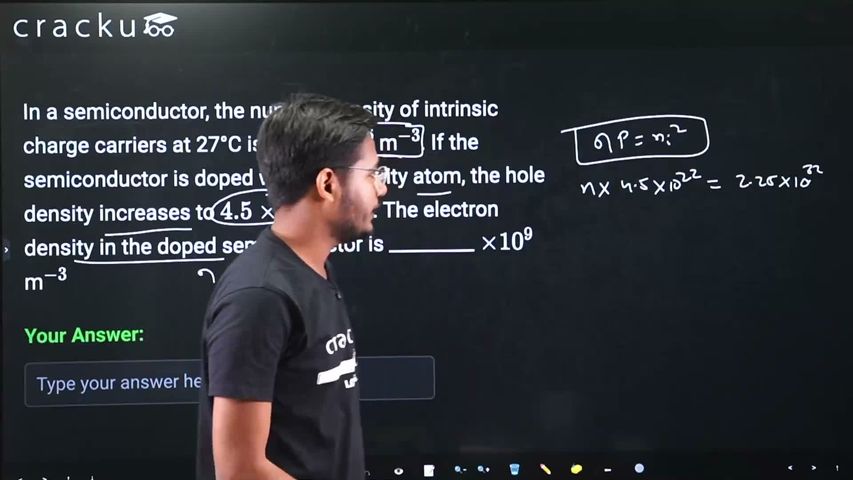
In a semiconductor, the number density of intrinsic charge carriers at 27°C is $$1.5 \times 10^{16}$$ m$$^{-3}$$. If the semiconductor is doped with an impurity atom, the hole density increases to $$4.5 \times 10^{22}$$ m$$^{-3}$$. The electron density in the doped semiconductor is _________ $$\times 10^{9}$$ m$$^{-3}$$
Correct Answer: 5
We have an intrinsic semiconductor at the same temperature before and after doping, so the law of mass action applies. This law states that for any semiconductor at a fixed temperature, the product of the free-electron density $$n$$ and the free-hole density $$p$$ remains equal to the square of the intrinsic carrier density $$n_i$$. Mathematically,
$$n\,p = n_i^{\,2}.$$
For the given intrinsic material, the intrinsic carrier density is
$$n_i = 1.5 \times 10^{16}\;\text{m}^{-3}.$$
Squaring this value gives
$$n_i^{\,2} = \left(1.5 \times 10^{16}\right)^{2} = 1.5^{2} \times 10^{32} = 2.25 \times 10^{32}\;\text{m}^{-6}.$$
After doping, the hole concentration becomes
$$p = 4.5 \times 10^{22}\;\text{m}^{-3}.$$
Substituting these values into the mass-action relation, we write
$$n \times p = n_i^{\,2} \quad\Longrightarrow\quad n = \frac{n_i^{\,2}}{p}.$$
Now we carry out the division explicitly:
$$n = \frac{2.25 \times 10^{32}}{4.5 \times 10^{22}} = \left(\frac{2.25}{4.5}\right) \times 10^{32-22} = 0.5 \times 10^{10} = 5 \times 10^{9}\;\text{m}^{-3}.$$
The problem asks for the electron concentration expressed in units of $$10^{9}\;\text{m}^{-3}$$, and we have found the numerical factor to be $$5$$.
So, the answer is $$5$$.
Was this solution helpful?
Click on the Email ☝️ to Watch the Video Solution
Create a FREE account and get:
_1.webp)

Educational materials for JEE preparation

Ask our AI anything

AI can make mistakes. Please verify important information.
AI can make mistakes. Please verify important information.
