
Join Our JEE Preparation Group
Prep with like-minded aspirants; Get access to free daily tests and study material.
Sign in
Please select an account to continue using cracku.in
↓ →
Join Our JEE Preparation Group
Prep with like-minded aspirants; Get access to free daily tests and study material.
The nuclear activity of a radioactive element becomes $$\left(\frac{1}{8}\right)^{th}$$ of its initial value in 30 years. The half-life of radioactive element is _________ years.
Correct Answer: 10
We begin by recalling that for any radioactive substance the activity (or rate of disintegration) at any instant is directly proportional to the number of undecayed nuclei present at that instant. Mathematically, the activity $$A$$ is related to the number of nuclei $$N$$ by $$A \propto N$$. Therefore, the fractional change in activity with time follows exactly the same exponential law as the number of nuclei.
The law of radioactive decay is usually written as
$$N(t)=N_0\;e^{-\lambda t},$$
where $$N_0$$ is the initial number of nuclei, $$\lambda$$ is the decay constant, and $$t$$ is time. Because activity is proportional to $$N$$, we may also write for activity
$$A(t)=A_0\;e^{-\lambda t},$$
with $$A_0$$ being the initial activity.
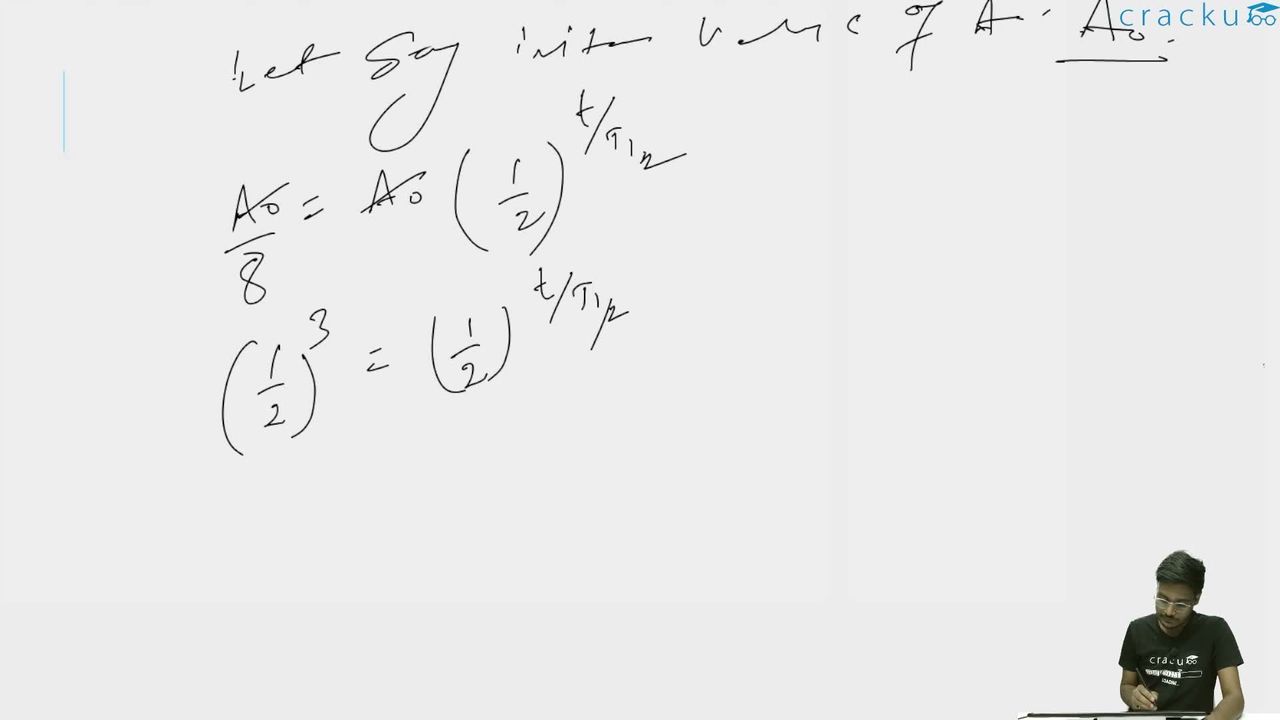
In the present problem we are told that after $$t = 30\ \text{years}$$, the activity falls to $$\dfrac{1}{8}$$ of its initial value. Translating this statement into the exponential formula we have
$$A(t)=\dfrac{1}{8}A_0 = A_0\,e^{-\lambda(30)}.$$
First we divide both sides by $$A_0$$ to isolate the exponential term:
$$\dfrac{1}{8}=e^{-\lambda(30)}.$$
Next we notice that $$\dfrac{1}{8}$$ can be expressed as a power of $$\dfrac{1}{2}$$:
$$\dfrac{1}{8} = \left(\dfrac{1}{2}\right)^3.$$
So we can rewrite the left-hand side as $$e^{-\lambda(30)} = \left(\dfrac{1}{2}\right)^3.$$ Taking natural logarithms (ln) on both sides, we obtain
$$-\lambda(30)=\ln\left[\left(\dfrac{1}{2}\right)^3\right].$$
Using the logarithm property $$\ln(a^b)=b\ln a$$ and noting that $$\ln\left(\dfrac{1}{2}\right)=-\ln 2$$, we get
$$-\lambda(30)=3\ln\left(\dfrac{1}{2}\right)=3(-\ln 2).$$
Simplifying both minus signs on the left and right gives
$$\lambda(30)=3\ln 2.$$
From this we solve for the decay constant $$\lambda$$:
$$\lambda=\dfrac{3\ln 2}{30}=\dfrac{\ln 2}{10}.$$
Now, the half-life $$T_{1/2}$$ is related to the decay constant by the well-known formula
$$T_{1/2}=\dfrac{\ln 2}{\lambda}.$$
Substituting the value of $$\lambda$$ that we just found, we have
$$T_{1/2}=\dfrac{\ln 2}{\dfrac{\ln 2}{10}}.$$
Because $$\ln 2$$ appears in both numerator and denominator, it cancels out completely:
$$T_{1/2}=10.$$
Thus the half-life of the radioactive element is $$10\ \text{years}$$.
So, the answer is $$10$$.
Was this solution helpful?
Click on the Email ☝️ to Watch the Video Solution
Create a FREE account and get:
_1.webp)

Educational materials for JEE preparation

Ask our AI anything

AI can make mistakes. Please verify important information.
AI can make mistakes. Please verify important information.
