
Join Our JEE Preparation Group
Prep with like-minded aspirants; Get access to free daily tests and study material.
Sign in
Please select an account to continue using cracku.in
↓ →
Join Our JEE Preparation Group
Prep with like-minded aspirants; Get access to free daily tests and study material.
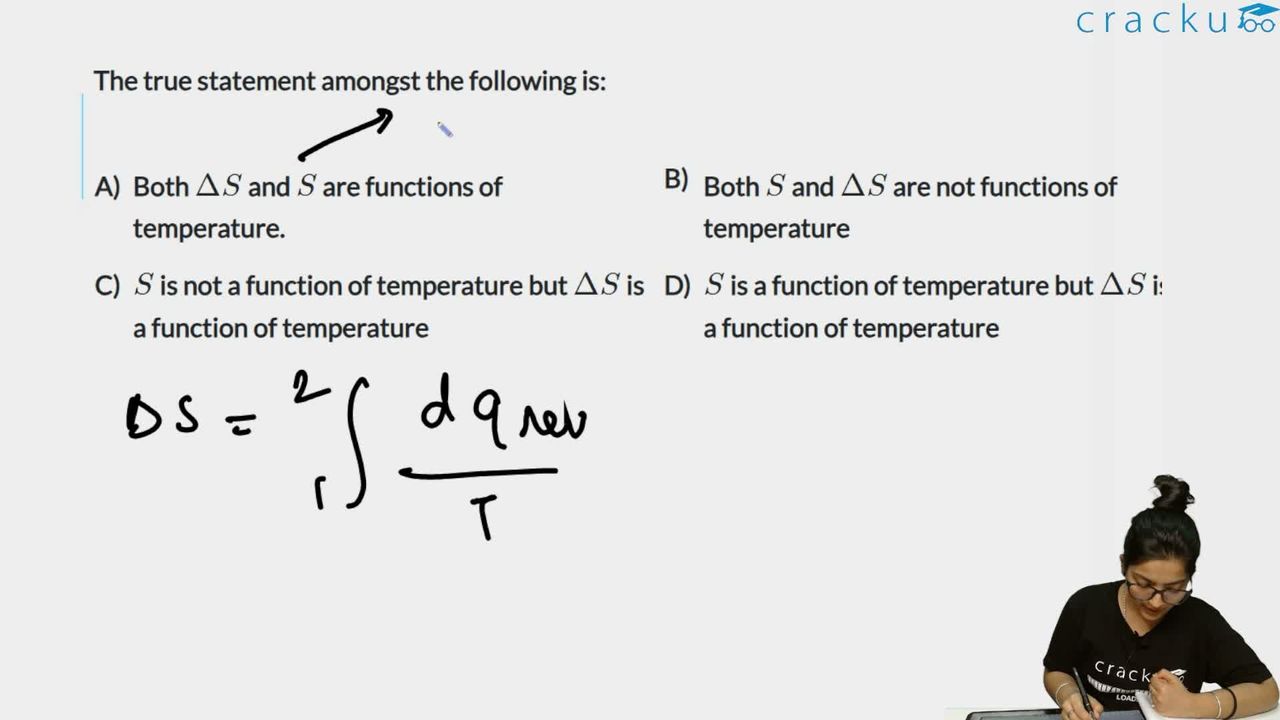
We begin by recalling the very definition of entropy. In differential form the entropy $$S$$ of a system is related to the reversible heat $$dq_{\text{rev}}$$ by the fundamental thermodynamic equation
$$dS=\dfrac{dq_{\text{rev}}}{T}\,,$$
where $$T$$ is the absolute temperature. This simple statement already hints that temperature plays a direct role in determining entropy.
To see the dependence explicitly, let us integrate the above relation between two equilibrium states 1 and 2 of a substance undergoing a reversible path. We write
$$\Delta S = S_2-S_1=\displaystyle\int_{1}^{2}\dfrac{dq_{\text{rev}}}{T}\,.$$
If the process is carried out at constant volume for an ideal gas, the reversible heat exchanged is given by the heat-capacity relation
$$dq_{\text{rev}}=nC_V\,dT\,,$$
where $$n$$ is the number of moles and $$C_V$$ is the molar heat capacity at constant volume. Substituting this in the integral we obtain
$$\Delta S = \displaystyle\int_{T_1}^{T_2}\dfrac{nC_V\,dT}{T} = nC_V\int_{T_1}^{T_2}\dfrac{dT}{T} = nC_V\ln\!\left(\dfrac{T_2}{T_1}\right).$$
The expression shows clearly that the change in entropy $$\Delta S$$ between the two states depends on the initial and final temperatures $$T_1$$ and $$T_2$$. Hence $$\Delta S$$ is a function of temperature.
Now let us turn to the absolute entropy $$S$$ itself. For a pure substance the absolute entropy at any temperature $$T$$ (above 0 K) is given by integrating from 0 K using the heat capacity data and including possible phase-transition contributions:
$$S(T)=\displaystyle\int_{0}^{T}\dfrac{C_P}{T'}\,dT' \;+\; \text{(entropy jumps at transitions)}.$$
Because the integrand $$C_P/T'$$ explicitly involves the variable temperature $$T'$$, the value of $$S$$ at a particular point obviously varies with $$T$$. Therefore the absolute entropy $$S$$ is also a function of temperature.
We have therefore established that
$$S = S(T) \quad\text{and}\quad \Delta S = \Delta S(T_1,T_2).$$
Both the quantity itself and its change depend on temperature. Examining the given statements, only Option A asserts that both $$S$$ and $$\Delta S$$ are functions of temperature.
Hence, the correct answer is Option A.
Was this solution helpful?
Click on the Email ☝️ to Watch the Video Solution
Create a FREE account and get:
_1.webp)

Educational materials for JEE preparation

Ask our AI anything

AI can make mistakes. Please verify important information.
AI can make mistakes. Please verify important information.
