
Join Our JEE Preparation Group
Prep with like-minded aspirants; Get access to free daily tests and study material.
Sign in
Please select an account to continue using cracku.in
↓ →
Join Our JEE Preparation Group
Prep with like-minded aspirants; Get access to free daily tests and study material.
We recall the periodic trend that as we move from left to right in a period, the nuclear charge increases while the added electrons enter the same principal shell. Because the effective nuclear charge ($$Z_{\text{eff}}$$) felt by the outermost electron increases, the first ionization energy—defined as the energy needed to remove one mole of electrons from one mole of gaseous atoms, $$M(g) \rightarrow M^{+}(g) + e^{-}$$—generally increases across a period.
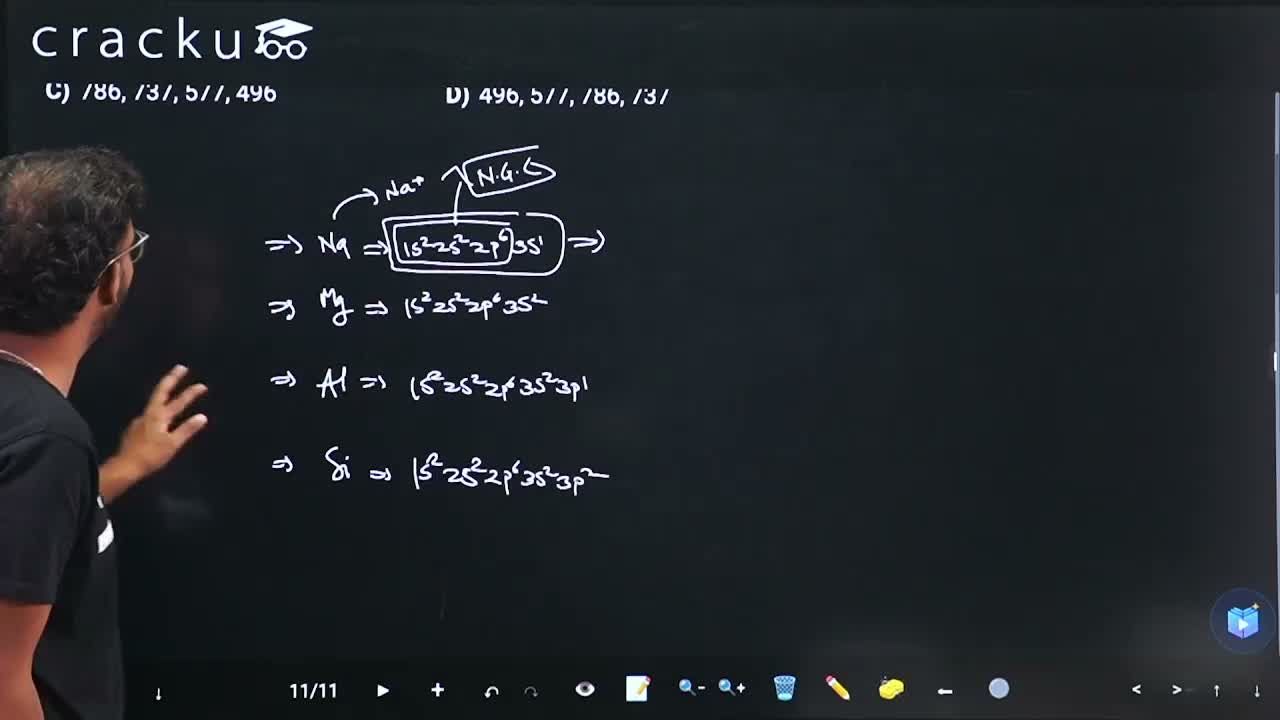
However, there are characteristic small drops when the added electron begins to occupy a new subshell of higher energy (such as from $$s$$ to $$p$$) or when electron-electron repulsion in a doubly occupied orbital becomes significant. In Period 3 the relevant electronic configurations are:
$$\begin{aligned} \text{Na} &:& [\text{Ne}]\,3s^{1} \\ \text{Mg} &:& [\text{Ne}]\,3s^{2} \\ \text{Al} &:& [\text{Ne}]\,3s^{2}\,3p^{1} \\ \text{Si} &:& [\text{Ne}]\,3s^{2}\,3p^{2} \end{aligned}$$
Starting with sodium, the single $$3s$$ electron is weakly held, so the first ionization energy is the smallest, about $$496\;\text{kJ mol}^{-1}$$.
Moving to magnesium, the outermost electron is still in the $$3s$$ subshell but the nucleus now has one extra proton. The additional positive charge outweighs the slight increase in shielding, so the ionization energy rises to approximately $$737\;\text{kJ mol}^{-1}$$.
For aluminium, the outermost electron enters the higher-energy $$3p$$ subshell. Because a $$3p$$ electron is less tightly held than a $$3s$$ electron, there is an anomalous dip despite the increasing nuclear charge. Consequently, the first ionization energy falls to about $$577\;\text{kJ mol}^{-1}$$.
Finally, in silicon the added electron pairs up in the $$3p$$ subshell, and the steadily increasing $$Z_{\text{eff}}$$ now dominates again. Hence the ionization energy climbs to roughly $$786\;\text{kJ mol}^{-1}$$.
Collecting the values in order Na, Mg, Al, Si we obtain:
$$496,\;737,\;577,\;786\;(\text{kJ mol}^{-1})$$
This exact sequence matches Option A.
Hence, the correct answer is Option A.
Was this solution helpful?
Click on the Email ☝️ to Watch the Video Solution
Create a FREE account and get:
Educational materials for JEE preparation

Ask our AI anything

AI can make mistakes. Please verify important information.
AI can make mistakes. Please verify important information.

_1.webp)
