
Join Our JEE Preparation Group
Prep with like-minded aspirants; Get access to free daily tests and study material.
Sign in
Please select an account to continue using cracku.in
↓ →
Join Our JEE Preparation Group
Prep with like-minded aspirants; Get access to free daily tests and study material.
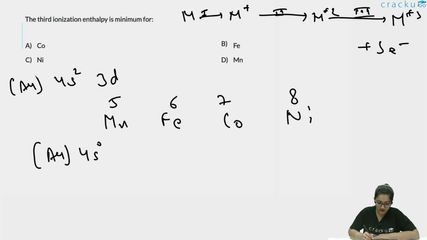
The third ionization enthalpy is the energy needed to pull out the third electron from a gaseous neutral atom. Symbolically we write the three successive steps as
$$\text{M}(g) \xrightarrow{\Delta_iH_1} \text{M}^+(g) + e^-,$$
$$\text{M}^+(g) \xrightarrow{\Delta_iH_2} \text{M}^{2+}(g) + e^-,$$
$$\text{M}^{2+}(g) \xrightarrow{\Delta_iH_3} \text{M}^{3+}(g) + e^-.$$
Here $$\Delta_iH_3$$ is the quantity we are comparing for Co, Fe, Ni and Mn.
Electrons are always removed first from the higher-energy $$4s$$ subshell and only afterwards from the $$3d$$ subshell. So, for any first-row transition element, the first two ionizations take away the two $$4s$$ electrons, and the third ionization removes the first $$3d$$ electron.
Let us write the ground-state electronic configurations (in the compact form using the argon core $$[\,\text{Ar}\,]$$):
Co : $$[\,\text{Ar}\,]\,3d^7\,4s^2$$
Fe : $$[\,\text{Ar}\,]\,3d^6\,4s^2$$
Ni : $$[\,\text{Ar}\,]\,3d^8\,4s^2$$
Mn : $$[\,\text{Ar}\,]\,3d^5\,4s^2$$
Now we remove electrons step by step.
Cobalt
First electron: $$[\,\text{Ar}\,]\,3d^7\,4s^2 \longrightarrow [\,\text{Ar}\,]\,3d^7\,4s^1$$
Second electron: $$[\,\text{Ar}\,]\,3d^7\,4s^1 \longrightarrow [\,\text{Ar}\,]\,3d^7$$
Third electron (from $$3d$$): $$[\,\text{Ar}\,]\,3d^7 \longrightarrow [\,\text{Ar}\,]\,3d^6$$
The resulting $$\text{Co}^{3+}$$ ion has configuration $$3d^6$$, which is neither half-filled ($$3d^5$$) nor fully filled ($$3d^{10}$$). Therefore no extra stability is gained, so $$\Delta_iH_3$$ is not especially low.
Iron
First electron: $$[\,\text{Ar}\,]\,3d^6\,4s^2 \longrightarrow [\,\text{Ar}\,]\,3d^6\,4s^1$$
Second electron: $$[\,\text{Ar}\,]\,3d^6\,4s^1 \longrightarrow [\,\text{Ar}\,]\,3d^6$$
Third electron (from $$3d$$): $$[\,\text{Ar}\,]\,3d^6 \longrightarrow [\,\text{Ar}\,]\,3d^5$$
Now the $$\text{Fe}^{3+}$$ ion possesses the exactly half-filled configuration $$3d^5$$. A half-filled subshell enjoys extra exchange-energy stabilization; hence the energy needed to reach this state (the third ionization enthalpy) is markedly lower than for neighbouring elements.
Nickel
First electron: $$[\,\text{Ar}\,]\,3d^8\,4s^2 \longrightarrow [\,\text{Ar}\,]\,3d^8\,4s^1$$
Second electron: $$[\,\text{Ar}\,]\,3d^8\,4s^1 \longrightarrow [\,\text{Ar}\,]\,3d^8$$
Third electron: $$[\,\text{Ar}\,]\,3d^8 \longrightarrow [\,\text{Ar}\,]\,3d^7$$
The $$3d^7$$ configuration is not especially stable, so $$\Delta_iH_3$$ remains comparatively high.
Manganese
First electron: $$[\,\text{Ar}\,]\,3d^5\,4s^2 \longrightarrow [\,\text{Ar}\,]\,3d^5\,4s^1$$
Second electron: $$[\,\text{Ar}\,]\,3d^5\,4s^1 \longrightarrow [\,\text{Ar}\,]\,3d^5$$
Third electron: $$[\,\text{Ar}\,]\,3d^5 \longrightarrow [\,\text{Ar}\,]\,3d^4$$
Here we destroy a half-filled subshell, so the third ionization enthalpy is actually very high, the opposite of what we want.
Among the four elements considered, only iron attains the extra-stable $$3d^5$$ arrangement after losing its third electron. This additional stability lowers the required energy, making $$\Delta_iH_3$$ minimal for iron.
Hence, the correct answer is Option B.
Was this solution helpful?
Click on the Email ☝️ to Watch the Video Solution
Create a FREE account and get:
_1.webp)

Educational materials for JEE preparation

Ask our AI anything

AI can make mistakes. Please verify important information.
AI can make mistakes. Please verify important information.
