
Join Our JEE Preparation Group
Prep with like-minded aspirants; Get access to free daily tests and study material.
Sign in
Please select an account to continue using cracku.in
↓ →
Join Our JEE Preparation Group
Prep with like-minded aspirants; Get access to free daily tests and study material.
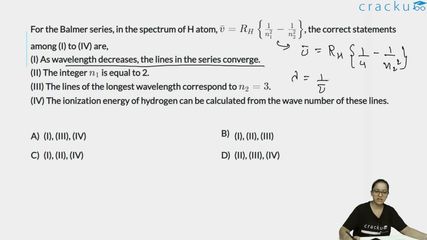
For the Balmer series, in the spectrum of H atom, $$\bar{v} = R_H\left\{\frac{1}{n_1^2} - \frac{1}{n_2^2}\right\}$$, the correct statements among (I) to (IV) are,
(I) As wavelength decreases, the lines in the series converge.
(II) The integer $$n_1$$ is equal to 2.
(III) The lines of the longest wavelength correspond to $$n_2 = 3$$.
(IV) The ionization energy of hydrogen can be calculated from the wave number of these lines.
We recall the general Rydberg-Balmer relation for any line in the emission spectrum of hydrogen:
$$\bar v \;=\; R_H\left\{ \frac1{n_1^{\,2}} - \frac1{n_2^{\,2}}\right\},\qquad n_2 \gt n_1,\; n_1 = 1,2,3,\ldots$$
In the particular case of the Balmer series we always have the lower, or stationary, level fixed at $$n_1 = 2$$ while the upper level can have the successive integral values $$n_2 = 3,4,5,\ldots$$ Substituting this fixed value of $$n_1$$ in the formula we obtain
$$\bar v_{\text{Balmer}} = R_H \left\{ \frac1{2^{\,2}} - \frac1{n_2^{\,2}}\right\} \;=\; R_H\left\{ \frac14 - \frac1{n_2^{\,2}}\right\}.$$
Now we test the four given statements one by one.
Statement (I): “As wavelength decreases, the lines in the series converge.”
Because $$n_2$$ appears in the denominator, increasing $$n_2$$ makes $$\dfrac1{n_2^{\,2}}$$ steadily smaller, so the bracket $$\left\{\dfrac14 - \dfrac1{n_2^{\,2}}\right\}$$ becomes larger and hence $$\bar v$$ (the wave number) increases. Since wavelength $$\lambda$$ is the reciprocal of wave number $$\bar v$$, viz. $$\lambda = 1/\bar v,$$ an increase in $$\bar v$$ implies a decrease in $$\lambda$$. Meanwhile the difference in $$\bar v$$ between successive $$n_2$$ values keeps shrinking, so the spectral lines crowd together. Thus the lines do indeed converge as the wavelength becomes shorter. Statement (I) is correct.
Statement (II): “The integer $$n_1$$ is equal to 2.”
We have already substituted $$n_1 = 2$$ for the Balmer series, so Statement (II) is correct.
Statement (III): “The lines of the longest wavelength correspond to $$n_2 = 3.$$”
The longest wavelength means the smallest wave number. Inspection of $$\bar v = R_H\!\left\{\dfrac14 - \dfrac1{n_2^{\,2}}\right\}$$ shows that the smallest possible value of $$\bar v$$ occurs for the smallest allowable $$n_2$$, which is $$n_2 = 3$$. Therefore the first Balmer line (from $$n_2=3$$ to $$n_1=2$$) has the greatest wavelength. Statement (III) is correct.
Statement (IV): “The ionization energy of hydrogen can be calculated from the wave number of these lines.”
The ionization energy is the energy required to remove the electron completely from the ground state $$n=1$$ to $$n=\infty$$. Its value is
$$E_{\text{ion}} = h c R_H.$$ Indeed, one can find $$R_H$$ if the ground-state Lyman lines (with $$n_1 = 1$$) or the series limit of any complete series are available. However, the Balmer series deals with transitions that start from $$n_1 = 2$$, so the Balmer data alone do not yield the energy gap between $$n=1$$ and $$n=\infty$$ unless additional information is supplied. Hence Statement (IV) is not correct when only Balmer lines are considered.
Summarising, the true statements are (I), (II) and (III), while (IV) is false.
Hence, the correct answer is Option B.
Was this solution helpful?
Click on the Email ☝️ to Watch the Video Solution
Create a FREE account and get:
_1.webp)

Educational materials for JEE preparation

Ask our AI anything

AI can make mistakes. Please verify important information.
AI can make mistakes. Please verify important information.
