
Join Our JEE Preparation Group
Prep with like-minded aspirants; Get access to free daily tests and study material.
Sign in
Please select an account to continue using cracku.in
↓ →
Join Our JEE Preparation Group
Prep with like-minded aspirants; Get access to free daily tests and study material.
Given below are two statements : one is labelled as Assertion (A) and the other is labelled as Reason (R).
Assertion (A) : The density of the copper $$\left(^{64}_{29}Cu\right)$$ nucleus is greater than that of the carbon $$\left(^{12}_{6}C\right)$$ nucleus.
Reason (R) : The nucleus of mass number A has a radius proportional to $$A^{1/3}$$.
In the light of the above statements, choose the most appropriate answer from the options given below :
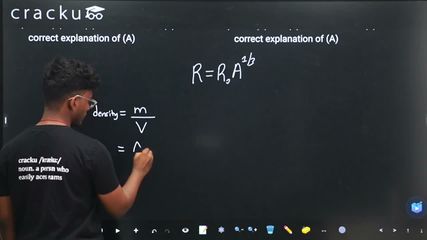
The nuclear radius empirical formula is $$R = r_0 A^{1/3}$$, where
$$R$$ = radius of the nucleus,
$$A$$ = mass number,
$$r_0$$ ≈ $$1.2 \times 10^{-15}\,$$m (a constant).
Hence the nuclear volume is
$$V = \frac{4}{3}\pi R^{3} = \frac{4}{3}\pi\left(r_0 A^{1/3}\right)^{3} = \frac{4}{3}\pi r_0^{3} A$$.
The mass of a nucleus is roughly $$A m_n$$, where $$m_n$$ is the nucleon mass (proton/neutron mass).
Therefore nuclear density is
$$\rho = \frac{\text{mass}}{\text{volume}} = \frac{A m_n}{\frac{4}{3}\pi r_0^{3} A} = \frac{m_n}{\tfrac{4}{3}\pi r_0^{3}}$$.
The factor $$A$$ cancels out, so $$\rho$$ is the same constant for all nuclei, independent of their mass numbers.
Assertion (A): “The density of the copper $$\left(^{64}_{29}Cu\right)$$ nucleus is greater than that of the carbon $$\left(^{12}_{6}C\right)$$ nucleus.”
We just showed that densities are practically identical for all nuclei, so Assertion (A) is incorrect.
Reason (R): “The nucleus of mass number $$A$$ has a radius proportional to $$A^{1/3}$$.”
This is exactly the empirical formula stated above, so Reason (R) is correct.
Thus, Assertion (A) is not correct but Reason (R) is correct. The appropriate choice is Option B.
Was this solution helpful?
Click on the Email ☝️ to Watch the Video Solution
Create a FREE account and get:
_1.webp)

Educational materials for JEE preparation

Ask our AI anything

AI can make mistakes. Please verify important information.
AI can make mistakes. Please verify important information.
