
Join Our JEE Preparation Group
Prep with like-minded aspirants; Get access to free daily tests and study material.
Sign in
Please select an account to continue using cracku.in
↓ →
Join Our JEE Preparation Group
Prep with like-minded aspirants; Get access to free daily tests and study material.
Given below are two statements : one is labelled as Assertion (A) and the other is labelled as Reason (R).
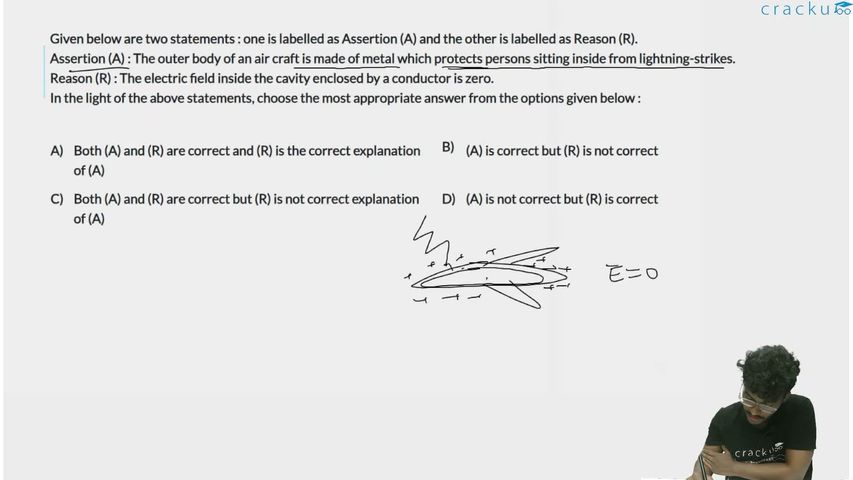
Assertion (A) : The outer body of an air craft is made of metal which protects persons sitting inside from lightning-strikes.
Reason (R) : The electric field inside the cavity enclosed by a conductor is zero.
In the light of the above statements, choose the most appropriate answer from the options given below :
An air-craft is essentially a hollow metallic body. When lightning (or any external electrostatic discharge) strikes it, charges get redistributed only on the outer metallic surface because of electrostatic induction.
For a conductor in electrostatic equilibrium, two well-known facts hold:
• The electric field $$\mathbf{E}$$ anywhere inside the conducting material is zero.
• Consequently, the electric field in any cavity completely surrounded by the conductor is also zero (principle of electrostatic shielding).
Hence, passengers seated inside the cabin experience no electric field; the metal fuselage acts as a Faraday cage that protects them from lightning. This confirms that Assertion (A) is a correct statement.
Reason (R) restates the principle used: “The electric field inside the cavity enclosed by a conductor is zero.” This statement is true and is exactly the physical explanation for the protection mentioned in (A).
Therefore, both Assertion (A) and Reason (R) are correct, and (R) is the correct explanation of (A).
The appropriate choice is Option A.
Was this solution helpful?
Click on the Email ☝️ to Watch the Video Solution
Create a FREE account and get:
_1.webp)

Educational materials for JEE preparation

Ask our AI anything

AI can make mistakes. Please verify important information.
AI can make mistakes. Please verify important information.
