
Join Our JEE Preparation Group
Prep with like-minded aspirants; Get access to free daily tests and study material.
Sign in
Please select an account to continue using cracku.in
↓ →
Join Our JEE Preparation Group
Prep with like-minded aspirants; Get access to free daily tests and study material.
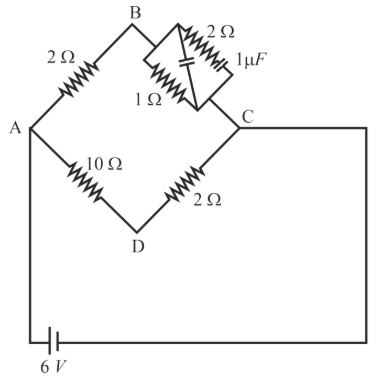
For the given circuit, in the steady state, $$|V_B - V_D|$$ = ______ V.
Correct Answer: 3
Steady State: In a DC circuit, once a capacitor is fully charged, no current flows through its branch ($$I_C = 0$$). This effectively removes the $$1\text{ }\mu\text{F}$$ capacitor and the $$1\text{ }\Omega$$ resistor in series with it from the active current path.
The circuit simplifies into two parallel branches ($$ABC$$ and $$ADC$$). We can find the potential at nodes $$B$$ and $$D$$ using the voltage divider rule.
In the upper branch $$ABC$$, the capacitor branch is open. Current only flows through the $$1\text{ }\Omega$$ (top-left) and the main $$2\text{ }\Omega$$ (top-right) resistors. Total resistance of branch $$ABC = 1\text{ }\Omega + 2\text{ }\Omega = 3\text{ }\Omega$$.
Using the voltage divider rule relative to $$C$$: $$V_B = V_A \times \frac{R_{BC}}{R_{AB} + R_{BC}} = 6\text{ V} \times \frac{2\text{ }\Omega}{1\text{ }\Omega + 2\text{ }\Omega}$$
$$V_B = 6 \times \frac{2}{3} = \mathbf{4\text{ V}}$$
In the lower branch $$ADC$$, the $$10\text{ }\Omega$$ and $$2\text{ }\Omega$$ resistors are in series. Total resistance of branch $$ADC = 10\text{ }\Omega + 2\text{ }\Omega = 12\text{ }\Omega$$. Using the voltage divider rule relative to $$C$$: $$V_D = V_A \times \frac{R_{DC}}{R_{AD} + R_{DC}} = 6\text{ V} \times \frac{2\text{ }\Omega}{10\text{ }\Omega + 2\text{ }\Omega}$$
$$V_D = 6 \times \frac{2}{12} = \mathbf{1\text{ V}}$$
$$|V_B - V_D| = |4\text{ V} - 1\text{ V}| = \mathbf{3\text{ V}}$$
Was this solution helpful?
Create a FREE account and get:
_1.webp)

Educational materials for JEE preparation

Ask our AI anything

AI can make mistakes. Please verify important information.
AI can make mistakes. Please verify important information.
