
Join Our JEE Preparation Group
Prep with like-minded aspirants; Get access to free daily tests and study material.
Sign in
Please select an account to continue using cracku.in
↓ →
Join Our JEE Preparation Group
Prep with like-minded aspirants; Get access to free daily tests and study material.
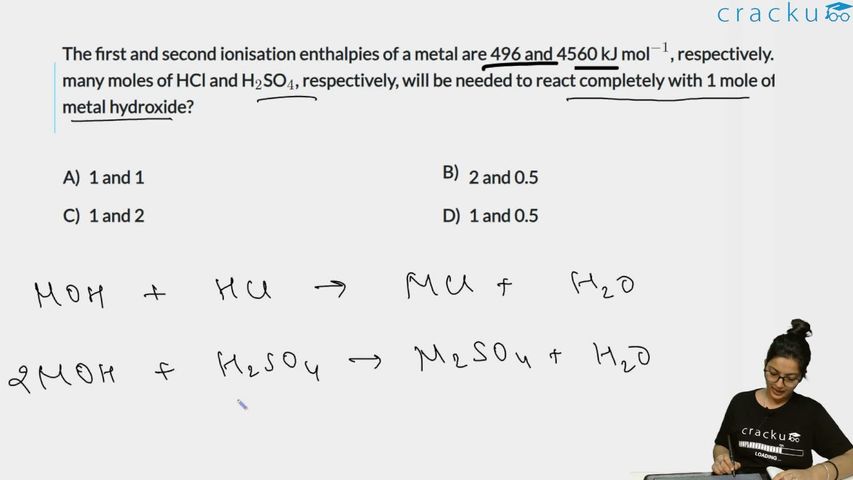
The first and second ionisation enthalpies of a metal are 496 and 4560 kJ mol$$^{-1}$$, respectively. How many moles of HCl and H$$_2$$SO$$_4$$, respectively, will be needed to react completely with 1 mole of the metal hydroxide?
We have been given the first ionisation enthalpy $$I_1 = 496\;{\rm kJ\;mol^{-1}}$$ and the second ionisation enthalpy $$I_2 = 4560\;{\rm kJ\;mol^{-1}}$$ for an unknown metal M. A very large jump from $$I_1$$ to $$I_2$$ tells us that, after one electron has been removed to give $$\mathrm{M^+}$$, removal of the second electron is energetically very unfavourable. In simple terms, the metal prefers the oxidation state $$+1$$.
If the metal forms a hydroxide, that hydroxide must therefore contain the monovalent cation $$\mathrm{M^+}$$. Combining charge balance with the monovalent anion $$\mathrm{OH^-}$$, the formula of the hydroxide is
$$\mathrm{MOH}.$$
Now we look at its reaction with hydrochloric acid. Writing the neutralisation reaction, we obtain
$$\mathrm{MOH + HCl \longrightarrow MCl + H_2O}.$$
The coefficients are all unity, so 1 mole of $$\mathrm{MOH}$$ consumes exactly 1 mole of $$\mathrm{HCl}$$.
Next we consider sulphuric acid. The reaction of the monobasic hydroxide with the dibasic acid is
$$2\,\mathrm{MOH + H_2SO_4 \longrightarrow M_2SO_4 + 2\,H_2O}.$$
Here 2 moles of the base react with 1 mole of $$\mathrm{H_2SO_4}$$. Dividing through by 2, we see that 1 mole of $$\mathrm{MOH}$$ requires
$$\dfrac{1}{2}\;{\rm mol} = 0.5\;{\rm mol}$$
of $$\mathrm{H_2SO_4}$$ for complete neutralisation.
Collecting the two results, to react completely with 1 mole of the metal hydroxide we need
$$1\;{\rm mol\;HCl} \quad\text{and}\quad 0.5\;{\rm mol\;H_2SO_4}.$$
Hence, the correct answer is Option D.
Was this solution helpful?
Click on the Email ☝️ to Watch the Video Solution
Create a FREE account and get:
_1.webp)

Educational materials for JEE preparation

Ask our AI anything

AI can make mistakes. Please verify important information.
AI can make mistakes. Please verify important information.
