
Join Our JEE Preparation Group
Prep with like-minded aspirants; Get access to free daily tests and study material.
Sign in
Please select an account to continue using cracku.in
↓ →
Join Our JEE Preparation Group
Prep with like-minded aspirants; Get access to free daily tests and study material.
A person lives in a high-rise building on the bank of a river 50 m wide. Across the river is a well lit tower of height 40 m. When the person, who is at a height of 10 m, looks through a polarizer at an appropriate angle at light of the tower reflecting from the river surface, he notes that intensity of light coming from distance X from his building is the least and this corresponds to the light coming from light bulbs at height 'Y' on the tower. The values of X and Y are respectively close to (refractive index of water $$\sim \frac{4}{3}$$)
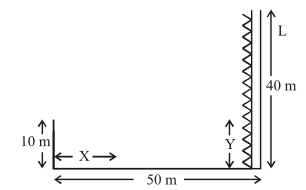
The light intensity is least when it reflects from the water surface at the Brewster angle ($$\theta_p$$), as the reflected light becomes completely polarized.
From Brewster's Law, the angle of incidence $$\theta_p$$ for which reflected light is perfectly polarized is $$\tan \theta_p = \mu = \frac{4}{3}$$
This implies that for the right-angled triangle formed by the light ray, the ratio of the opposite side (horizontal distance) to the adjacent side (vertical height) is $$4/3$$.
The person is at a height $$h = 10\text{ m}$$. The light ray reflected from distance $$X$$ enters the person's eye at the angle $$\theta_p$$ with the normal.
$$\tan \theta_p = \frac{X}{h} = \frac{X}{10}$$
$$\frac{4}{3} = \frac{X}{10} \implies X = \frac{40}{3} \approx 13.33\text{ m}$$
The distance from the point of reflection to the tower is $$(50 - X)$$. For the ray coming from height $$Y$$ on the tower to reflect at the same point with the same Brewster angle: $$\tan \theta_p = \frac{50 - X}{Y}$$
$$\frac{4}{3} = \frac{50 - 13.33}{Y}$$
$$Y = \frac{3}{4} \times 36.67 \approx 27.5\text{ m}$$
Was this solution helpful?
Create a FREE account and get:
_1.webp)

Educational materials for JEE preparation

Ask our AI anything

AI can make mistakes. Please verify important information.
AI can make mistakes. Please verify important information.


