
Join Our JEE Preparation Group
Prep with like-minded aspirants; Get access to free daily tests and study material.
Sign in
Please select an account to continue using cracku.in
↓ →
Join Our JEE Preparation Group
Prep with like-minded aspirants; Get access to free daily tests and study material.
A ray of light of intensity I is incident on a parallel glass slab at point A as shown in the diagram. It undergoes partial reflection and refraction. At each reflection, 25% of incident energy is reflected. The rays AB and A'B' undergo interference. The ratio of $$I_{max}$$ and $$I_{min}$$ is :
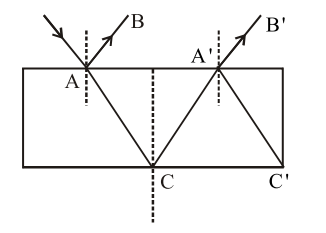
Ray AB is produced by the first partial reflection at point A.
Reflection Coefficient ($$R$$): $$25\%$$ or $$0.25$$. Intensity ($$I_1$$): $$I_1 = R \times I = \mathbf{0.25 I}$$.
Ray A'B' follows a path of refraction, reflection, and another refraction.
Transmission Coefficient ($$T$$): $$1 - 0.25 = 0.75$$.
At point A (Refraction): Intensity enters the slab = $$T \times I = 0.75 I$$.
At point C (Reflection): Intensity inside = $$R \times (0.75 I) = 0.25 \times 0.75 I = 0.1875 I$$.
At point A' (Refraction): Intensity exiting as ray A'B' = $$T \times (0.1875 I) = 0.75 \times 0.1875 I = \mathbf{0.140625 I}$$.
Intensity ($$I$$) is proportional to the square of the Amplitude ($$A$$). Therefore, $$A \propto \sqrt{I}$$.
$$\frac{A_1}{A_2} = \sqrt{\frac{I_1}{I_2}} = \sqrt{\frac{0.25 I}{0.140625 I}} = \sqrt{\frac{1/4}{9/64}} = \sqrt{\frac{16}{9}} = \mathbf{\frac{4}{3}}$$.
$$I_{max} \propto (A_1 + A_2)^2 \quad \text{and} \quad I_{min} \propto (A_1 - A_2)^2$$
$$\frac{I_{max}}{I_{min}} = \left( \frac{A_1 + A_2}{A_1 - A_2} \right)^2$$
$$\frac{I_{max}}{I_{min}} = \left( \frac{4 + 3}{4 - 3} \right)^2 = \left( \frac{7}{1} \right)^2 = \mathbf{49 : 1}$$
Was this solution helpful?
Create a FREE account and get:
_1.webp)

Educational materials for JEE preparation

Ask our AI anything

AI can make mistakes. Please verify important information.
AI can make mistakes. Please verify important information.


