
Join Our JEE Preparation Group
Prep with like-minded aspirants; Get access to free daily tests and study material.
Sign in
Please select an account to continue using cracku.in
↓ →
Join Our JEE Preparation Group
Prep with like-minded aspirants; Get access to free daily tests and study material.
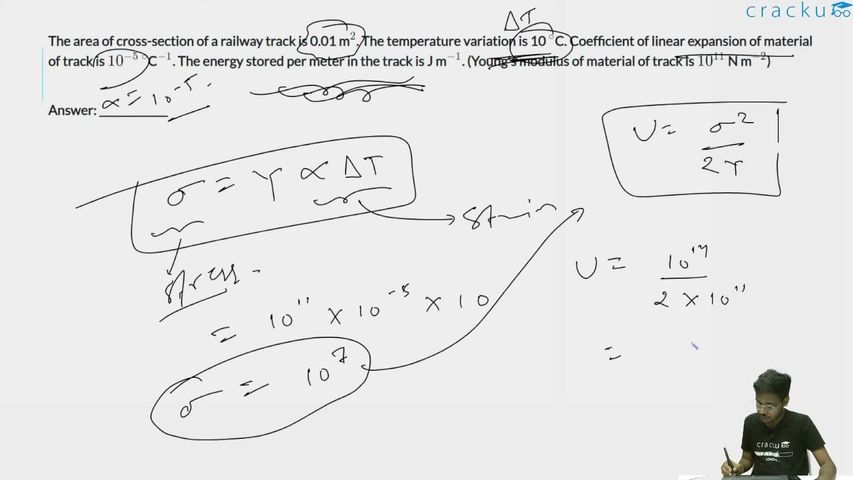
The area of cross-section of a railway track is 0.01 m$$^2$$. The temperature variation is 10 $$^\circ$$C. Coefficient of linear expansion of material of track is $$10^{-5}$$ $$^\circ$$C$$^{-1}$$. The energy stored per meter in the track is J m$$^{-1}$$. (Young's modulus of material of track is $$10^{11}$$ N m$$^{-2}$$)
Correct Answer: 5
When the temperature of a constrained railway track rises by $$\Delta T = 10\,^\circ\text{C}$$, the track cannot expand freely, so a compressive thermal stress is set up. The thermal strain is $$\alpha\,\Delta T$$ and the corresponding thermal stress is:
$$\sigma = Y\,\alpha\,\Delta T = 10^{11} \times 10^{-5} \times 10 = 10^7\,\text{N\,m}^{-2}$$
The elastic energy stored per unit volume is:
$$u = \frac{\sigma^2}{2Y} = \frac{(10^7)^2}{2 \times 10^{11}} = \frac{10^{14}}{2 \times 10^{11}} = 500\,\text{J\,m}^{-3}$$
The energy stored per metre of the track equals the energy per unit volume multiplied by the cross-sectional area:
$$U = u \times A = 500 \times 0.01 = 5\,\text{J\,m}^{-1}$$
Therefore, the energy stored per metre in the track is $$5\,\text{J\,m}^{-1}$$.
Click on the Email ☝️ to Watch the Video Solution
Create a FREE account and get:
_1.webp)

Educational materials for JEE preparation

Ask our AI anything

AI can make mistakes. Please verify important information.
AI can make mistakes. Please verify important information.


