
Join Our JEE Preparation Group
Prep with like-minded aspirants; Get access to free daily tests and study material.
Sign in
Please select an account to continue using cracku.in
↓ →
Join Our JEE Preparation Group
Prep with like-minded aspirants; Get access to free daily tests and study material.
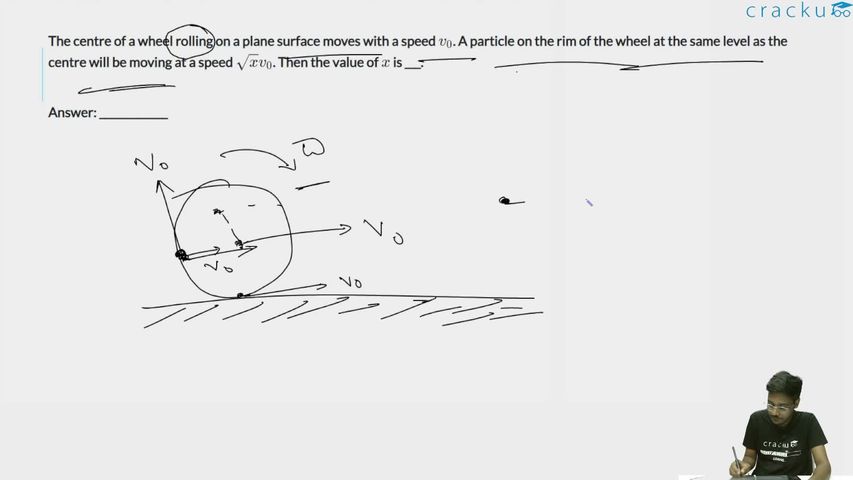
The centre of a wheel rolling on a plane surface moves with a speed $$v_0$$. A particle on the rim of the wheel at the same level as the centre will be moving at a speed $$\sqrt{x}v_0$$. Then the value of $$x$$ is ___.
Correct Answer: 2
For a wheel of radius $$R$$ rolling without slipping on a flat surface, the centre of the wheel moves with speed $$v_0$$. The rolling condition gives the angular velocity as $$\omega = v_0/R$$, directed (for rightward motion) clockwise, i.e. $$\vec{\omega} = -\dfrac{v_0}{R}\hat{k}$$.
A particle on the rim at the same height as the centre is positioned either to the left or right of the centre. Consider the particle at position $$\vec{r} = R\hat{i}$$ relative to the centre (i.e., at the rightmost point of the wheel, at the same height as the centre).
The velocity of this particle is the sum of the centre-of-mass velocity and the rotational velocity:
$$\vec{v} = v_0\hat{i} + \vec{\omega} \times \vec{r} = v_0\hat{i} + \left(-\frac{v_0}{R}\hat{k}\right) \times (R\hat{i}) = v_0\hat{i} - v_0(\hat{k}\times\hat{i}) = v_0\hat{i} - v_0\hat{j}$$
The speed is:
$$|\vec{v}| = \sqrt{v_0^2 + v_0^2} = v_0\sqrt{2} = \sqrt{2}\,v_0$$
Comparing with the given form $$\sqrt{x}\,v_0$$, the value of $$x$$ is $$2$$.
Was this solution helpful?
Click on the Email ☝️ to Watch the Video Solution
Create a FREE account and get:
_1.webp)

Educational materials for JEE preparation

Ask our AI anything

AI can make mistakes. Please verify important information.
AI can make mistakes. Please verify important information.
