
Join Our JEE Preparation Group
Prep with like-minded aspirants; Get access to free daily tests and study material.
Sign in
Please select an account to continue using cracku.in
↓ →
Join Our JEE Preparation Group
Prep with like-minded aspirants; Get access to free daily tests and study material.
Formation of real image using a biconvex lens is shown below.
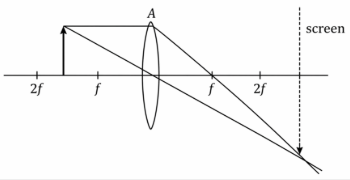
If the whole set up is immersed in water without disturbing the object and the screen positions, what will one observe on the screen?
We are given a thin bi-convex lens which, in air, produces a sharp real image of an object on a fixed screen. Let the object distance from the lens be denoted by $$u$$ (measured from the lens with the usual sign convention, so in air $$u<0$$), and let the screen be at distance $$v$$ (so in air $$v>0$$). Because the image is sharp, the thin-lens equation in air holds:
$$\frac1f=\frac1v-\frac1u\;.$$
Here $$f$$ is the focal length of the lens in air. Now we write the focal length in terms of the radii of curvature of the two spherical surfaces by first stating the Lens-Maker’s formula. For a thin lens whose material has refractive index $$\mu_g$$ and which is placed in a medium of refractive index $$\mu_m,$$ the formula is
$$\frac1f=\Bigl(\frac{\mu_g}{\mu_m}-1\Bigr)\Bigl(\frac1{R_1}-\frac1{R_2}\Bigr).$$
For a symmetrical bi-convex lens the first surface has radius $$R_1=+R$$ (center to the right of the surface) and the second has radius $$R_2=-R$$ (center to the left of the surface). Hence in air (where $$\mu_m=1$$)
$$\frac1{f_{\text{air}}}=\bigl(\mu_g-1\bigr)\Bigl(\frac1R-\frac1{(-R)}\Bigr) =\bigl(\mu_g-1\bigr)\Bigl(\frac1R+\frac1R\Bigr) =\frac{2(\mu_g-1)}R.$$
Next we immerse the entire arrangement—lens, object, and screen—into water, taking care not to disturb the positions of the object and screen. The surrounding medium now has refractive index $$\mu_w\;( \approx 1.33).$$ The glass of the lens still has index $$\mu_g\;( \approx 1.50).$$ Therefore the focal length in water becomes
$$\frac1{f_{\text{water}}} =\Bigl(\frac{\mu_g}{\mu_w}-1\Bigr)\Bigl(\frac1R-\frac1{(-R)}\Bigr) =\Bigl(\frac{\mu_g}{\mu_w}-1\Bigr)\frac{2}{R}.$$
Numerically,
$$\frac{\mu_g}{\mu_w}-1 =\frac{1.50}{1.33}-1 \approx1.1278-1 =0.1278.$$
Comparing this with the value in air, where the factor was $$\mu_g-1\approx0.50,$$ we see that
$$\frac1{f_{\text{water}}}=\frac{0.1278}{0.50}\;\frac1{f_{\text{air}}} \approx0.256\;\frac1{f_{\text{air}}},$$
so
$$f_{\text{water}}\approx3.9\,f_{\text{air}}.$$
Thus the focal length almost quadruples. Now consider the thin-lens equation again after immersion:
$$\frac1{f_{\text{water}}}=\frac1{v_{\text{new}}}-\frac1{u_{\text{same}}}.$$
The object distance $$u_{\text{same}}$$ is unchanged because we have not moved the object. The screen, however, is still at the old position $$v$$ (the one that satisfied the equation with $$f_{\text{air}}$$). Because $$f_{\text{water}}$$ is very much larger than $$f_{\text{air}},$$ the right-hand side calculated with the old $$u$$ and $$v$$ will no longer equal the new left-hand side. Consequently the equality fails, so the image point shifts away from the screen position.
If one now looks at the screen, the convergence of rays is no longer at the screen surface. Rays arrive either before or after the screen, producing a diffuse blur; a well-defined real image is not obtained at the screen location. To the observer the sharp image simply vanishes.
Therefore, upon immersing the arrangement in water without altering object or screen distances, the sharp real image disappears from the screen.
Hence, the correct answer is Option A.
Was this solution helpful?
Create a FREE account and get:
_1.webp)

Educational materials for JEE preparation

Ask our AI anything

AI can make mistakes. Please verify important information.
AI can make mistakes. Please verify important information.


