
Join Our JEE Preparation Group
Prep with like-minded aspirants; Get access to free daily tests and study material.
Sign in
Please select an account to continue using cracku.in
↓ →
Join Our JEE Preparation Group
Prep with like-minded aspirants; Get access to free daily tests and study material.
Let S denote the set of 4-digit numbers $$abcd$$ such that $$a > b > c > d$$ and P denote the set of 5-digit numbers having product of its digits equal to 20. Then $$n(S) + n(P)$$ is equal to ______
Correct Answer: 260
Calculating $$n(S)$$:
The number of 4-digit numbers $$abcd$$ such that $$a > b > c > d$$ can be calculated by selecting 4 digits out of the digits 0, 1, 2,..., 9 and arranging them in descending order. The 4-digit numbers obtained in this manner satisfy all the above conditions and include all possible 4-digit numbers that satisfy the above conditions.
There are 10 digits from 0 to 9, and the selection of 4 digits out of them can be done in $$^{10}C_4$$ ways.
$$n(S)=\ ^{10}C_4\ =\ \dfrac{10!}{6!\ \times\ 4!}\ =\ \dfrac{10\times\ 9\times\ 8\times\ 7}{1\times\ 2\times\ 3\times\ 4}\ =\ 210$$
Calculating $$n(P)$$:
We need to find the sets of 5 single-digit numbers whose product equals 20.
$$20\ =\ 2^2\ \times\ 5\ =\ 5\ \times\ 2\ \times\ 2$$
So, the only possible sets of 5 digits with a product equal to 20 are {5, 2, 2, 1, 1} and {5, 4, 1, 1, 1}.
The number of 5-digit numbers possible using the 5 digits {5, 2, 2, 1, 1} can be calculated as $$\dfrac{5!}{2!\ \times\ 2!}\ =\ 30$$ as there are 2 twos and 2 ones.
The number of 5-digit numbers possible using the 5 digits {5, 4, 1, 1, 1} can be calculated as $$\dfrac{5!}{3!}\ =\ 20$$ as there are 3 ones.
$$n\left(P\right)\ =\ 20\ +\ 30\ =\ 50$$
$$n\left(S\right)\ +\ n\left(P\right)\ =\ 210\ +\ 50\ =\ 260$$
Hence, the correct answer is 260.
Was this solution helpful?
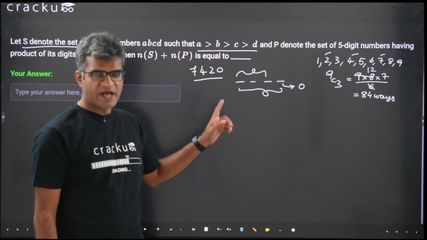
Click on the Email ☝️ to Watch the Video Solution
Create a FREE account and get:
_1.webp)

Educational materials for JEE preparation

Ask our AI anything

AI can make mistakes. Please verify important information.
AI can make mistakes. Please verify important information.
