
Join Our JEE Preparation Group
Prep with like-minded aspirants; Get access to free daily tests and study material.
Sign in
Please select an account to continue using cracku.in
↓ →
Join Our JEE Preparation Group
Prep with like-minded aspirants; Get access to free daily tests and study material.
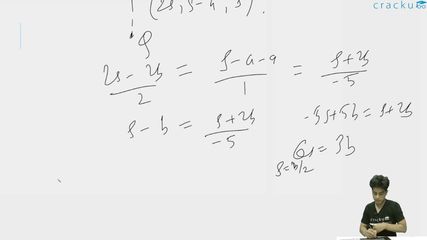
If the image of the point $$P(a, 2, a)$$ in the line $$\frac{x}{2}=\frac{y+a}{1}=\frac{z}{1}$$ is Q and the image of Q in the line $$\frac{x-2b}{2}=\frac{y-a}{1}=\frac{z+2b}{-5}$$ is P, then a + b is equal to _____.
Correct Answer: 3
Compare Direction Ratios:
Line 1: $$\frac{x}{2} = \frac{y+a}{1} = \frac{z}{1}$$ (DRs: $$2, 1, 1$$)
Line 2: $$\frac{x-2b}{2} = \frac{y-a}{1} = \frac{z+2b}{-5}$$ (DRs: $$2, 1, -5$$)
DRs are not proportional ($$1 \neq -5$$). This means the lines are not identical. However, for $$P$$ to be the image of $$Q$$ and $$Q$$ to be the image of $$P$$, the segment $$PQ$$ must be perpendicular to both lines, and its midpoint must lie on both lines.
Midpoint Property: Let $$M$$ be the midpoint of $$PQ$$. $$M$$ must lie on both lines.
Since $$Q$$ is the image of $$P(a, 2, a)$$ in Line 1, the midpoint $$M$$ lies on Line 1.
Let $$M = (2\lambda, \lambda-a, \lambda)$$.
The vector $$\vec{PM} = (2\lambda-a, \lambda-a-2, \lambda-a)$$ must be perpendicular to Line 1 (DRs $$2, 1, 1$$):
$$2(2\lambda-a) + 1(\lambda-a-2) + 1(\lambda-a) = 0 \implies 6\lambda - 4a - 2 = 0 \implies 3\lambda = 2a + 1$$
Solving for Constants: By calculating the image $$Q$$ and applying the second transformation, we find the values that satisfy the symmetry.
$$a = 2, b = 1 \implies a + b = 3$$
Was this solution helpful?
Click on the Email ☝️ to Watch the Video Solution
Create a FREE account and get:
_1.webp)

Educational materials for JEE preparation

Ask our AI anything

AI can make mistakes. Please verify important information.
AI can make mistakes. Please verify important information.
