
Join Our JEE Preparation Group
Prep with like-minded aspirants; Get access to free daily tests and study material.
Sign in
Please select an account to continue using cracku.in
↓ →
Join Our JEE Preparation Group
Prep with like-minded aspirants; Get access to free daily tests and study material.
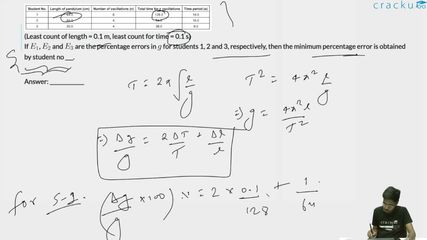
Three students $$S_1$$, $$S_2$$ and $$S_3$$ perform an experiment for determining the acceleration due to gravity $$(g)$$ using a simple pendulum. They use different lengths of pendulum and record time for different number of oscillations. The observations are as shown in the table.

(Least count of length = 0.1 m, least count for time = 0.1 s)
If $$E_1$$, $$E_2$$ and $$E_3$$ are the percentage errors in $$g$$ for students 1, 2 and 3, respectively, then the minimum percentage error is obtained by student no ___.
Correct Answer: 1
For a simple pendulum, $$g = \dfrac{4\pi^2 L}{T^2}$$ where $$T$$ is the time period. The percentage error in $$g$$ is:
$$\frac{\Delta g}{g} \times 100 = \frac{\Delta L}{L} \times 100 + 2\,\frac{\Delta T}{T} \times 100$$
where $$T = t_{\text{total}}/n$$, so $$\Delta T = \Delta t/n$$ and $$\dfrac{\Delta T}{T} = \dfrac{\Delta t}{t_{\text{total}}}$$.
The table gives: Student $$S_1$$: $$L = 1.0\,\text{m}$$, $$n = 10$$ oscillations, $$t_{\text{total}} = 20.0\,\text{s}$$; Student $$S_2$$: $$L = 0.5\,\text{m}$$, $$n = 20$$, $$t_{\text{total}} = 40.0\,\text{s}$$; Student $$S_3$$: $$L = 0.9\,\text{m}$$, $$n = 15$$, $$t_{\text{total}} = 45.0\,\text{s}$$. The least count of length is $$0.1\,\text{m}$$ and of time is $$0.1\,\text{s}$$.
For $$S_1$$: $$E_1 = \left(\dfrac{0.1}{1.0} + 2 \times \dfrac{0.1}{20.0}\right) \times 100 = (0.10 + 0.01) \times 100 = 11\%$$
For $$S_2$$: $$E_2 = \left(\dfrac{0.1}{0.5} + 2 \times \dfrac{0.1}{40.0}\right) \times 100 = (0.20 + 0.005) \times 100 = 20.5\%$$
For $$S_3$$: $$E_3 = \left(\dfrac{0.1}{0.9} + 2 \times \dfrac{0.1}{45.0}\right) \times 100 \approx (0.111 + 0.0044) \times 100 \approx 11.6\%$$
Comparing the three, $$E_1 = 11\% < E_3 \approx 11.6\% < E_2 = 20.5\%$$. The minimum percentage error is obtained by student number $$1$$.
Was this solution helpful?
Click on the Email ☝️ to Watch the Video Solution
Create a FREE account and get:
_1.webp)

Educational materials for JEE preparation

Ask our AI anything

AI can make mistakes. Please verify important information.
AI can make mistakes. Please verify important information.
