
Join Our JEE Preparation Group
Prep with like-minded aspirants; Get access to free daily tests and study material.
Sign in
Please select an account to continue using cracku.in
↓ →
Join Our JEE Preparation Group
Prep with like-minded aspirants; Get access to free daily tests and study material.
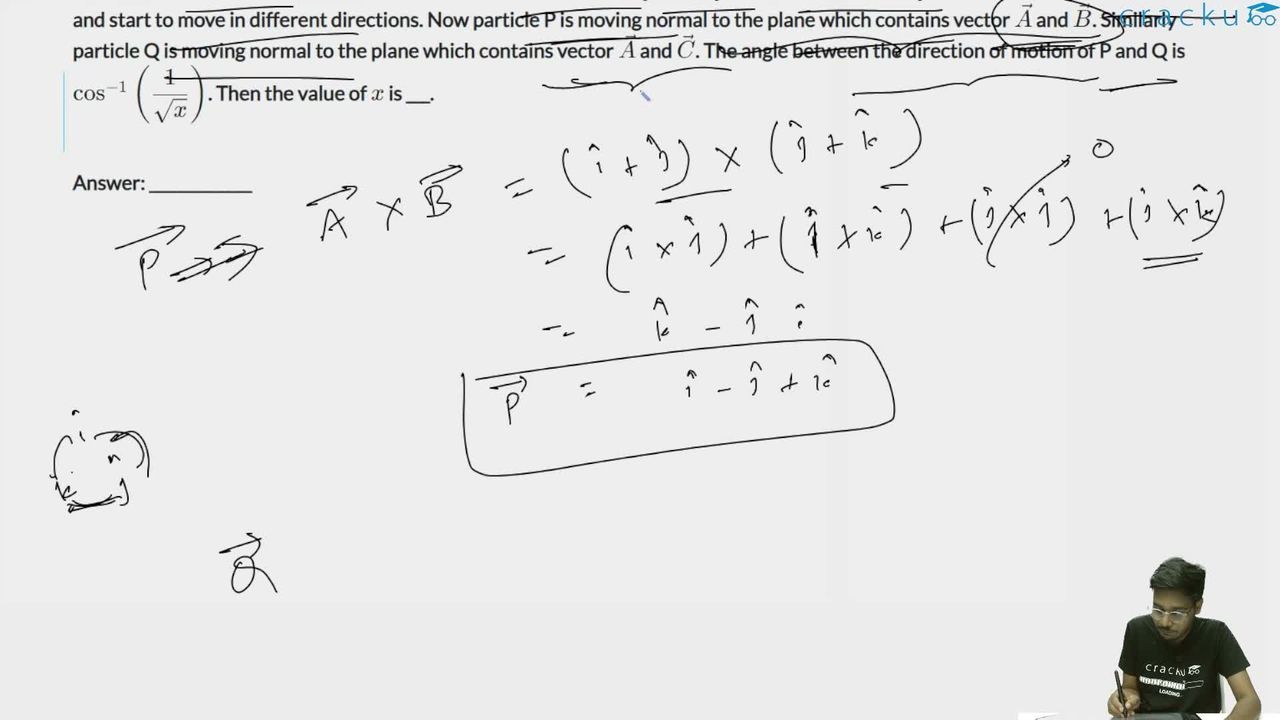
Three particles P, Q and R are moving along the vectors $$\vec{A} = \hat{i} + \hat{j}$$, $$\vec{B} = \hat{j} + \hat{k}$$ and $$\vec{C} = -\hat{i} + \hat{j}$$, respectively. They strike on a point and start to move in different directions. Now particle P is moving normal to the plane which contains vector $$\vec{A}$$ and $$\vec{B}$$. Similarly particle Q is moving normal to the plane which contains vector $$\vec{A}$$ and $$\vec{C}$$. The angle between the direction of motion of P and Q is $$\cos^{-1}\left(\dfrac{1}{\sqrt{x}}\right)$$. Then the value of $$x$$ is ___.
Correct Answer: 3
Particle P moves along $$\vec{A} = \hat{i} + \hat{j}$$ and then along a direction normal to the plane containing $$\vec{A}$$ and $$\vec{B} = \hat{j} + \hat{k}$$. So the direction of P after the collision is $$\vec{A} \times \vec{B}$$.
$$\vec{A} \times \vec{B} = (\hat{i} + \hat{j}) \times (\hat{j} + \hat{k}) = \hat{i}\times\hat{j} + \hat{i}\times\hat{k} + \hat{j}\times\hat{j} + \hat{j}\times\hat{k}$$ $$= \hat{k} - \hat{j} + 0 + \hat{i} = \hat{i} - \hat{j} + \hat{k}$$
Particle Q moves along $$\vec{A} = \hat{i} + \hat{j}$$ and then along a direction normal to the plane containing $$\vec{A}$$ and $$\vec{C} = -\hat{i} + \hat{j}$$. So the direction of Q after the collision is $$\vec{A} \times \vec{C}$$.
$$\vec{A} \times \vec{C} = (\hat{i} + \hat{j}) \times (-\hat{i} + \hat{j}) = \hat{i}\times(-\hat{i}) + \hat{i}\times\hat{j} + \hat{j}\times(-\hat{i}) + \hat{j}\times\hat{j}$$ $$= 0 + \hat{k} + \hat{k} + 0 = 2\hat{k}$$
The angle $$\theta$$ between these two directions is found using the dot product formula:
$$\cos\theta = \dfrac{(\hat{i} - \hat{j} + \hat{k}) \cdot (2\hat{k})}{|\hat{i} - \hat{j} + \hat{k}| \times |2\hat{k}|}$$
The numerator is $$2$$, and the denominator is $$\sqrt{1^2 + (-1)^2 + 1^2} \times 2 = \sqrt{3} \times 2$$.
$$\cos\theta = \frac{2}{2\sqrt{3}} = \frac{1}{\sqrt{3}}$$
Comparing with $$\cos^{-1}\!\left(\dfrac{1}{\sqrt{x}}\right)$$, we get $$x = 3$$.
Was this solution helpful?
Click on the Email ☝️ to Watch the Video Solution
Create a FREE account and get:
_1.webp)

Educational materials for JEE preparation

Ask our AI anything

AI can make mistakes. Please verify important information.
AI can make mistakes. Please verify important information.
