
Join Our JEE Preparation Group
Prep with like-minded aspirants; Get access to free daily tests and study material.
Sign in
Please select an account to continue using cracku.in
↓ →
Join Our JEE Preparation Group
Prep with like-minded aspirants; Get access to free daily tests and study material.
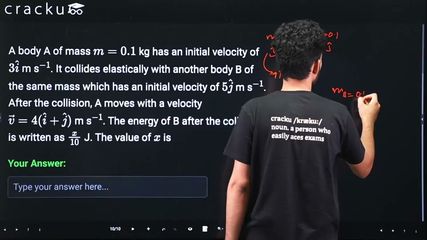
A body A of mass $$m = 0.1$$ kg has an initial velocity of $$3\hat{i}$$ m s$$^{-1}$$. It collides elastically with another body B of the same mass which has an initial velocity of $$5\hat{j}$$ m s$$^{-1}$$. After the collision, A moves with a velocity $$\vec{v} = 4(\hat{i} + \hat{j})$$ m s$$^{-1}$$. The energy of B after the collision is written as $$\frac{x}{10}$$ J. The value of $$x$$ is
Correct Answer: 1
We have two bodies, both of mass $$m = 0.1\ \text{kg}$$.
The initial velocity of body A is $$\vec u_A = 3\hat i\ \text{m s}^{-1}$$ and that of body B is $$\vec u_B = 5\hat j\ \text{m s}^{-1}$$.
After an elastic collision, body A is given to move with $$\vec v_A = 4(\hat i + \hat j) = 4\hat i + 4\hat j\ \text{m s}^{-1}$$. Let the final velocity of body B be $$\vec v_B = v_{Bx}\hat i + v_{By}\hat j$$.
Because the collision is isolated, the total linear momentum is conserved. The law of conservation of momentum states $$m\vec u_A + m\vec u_B = m\vec v_A + m\vec v_B.$$
Substituting every known vector and cancelling the common mass $$m$$ on both sides gives
$$3\hat i + 5\hat j = (4\hat i + 4\hat j) + (v_{Bx}\hat i + v_{By}\hat j).$$
Now we equate the components separately:
For the $$\hat i$$ component: $$3 = 4 + v_{Bx}\ \Longrightarrow\ v_{Bx} = 3 - 4 = -1.$$
For the $$\hat j$$ component: $$5 = 4 + v_{By}\ \Longrightarrow\ v_{By} = 5 - 4 = 1.$$
So the velocity of body B after the collision is
$$\vec v_B = -1\hat i + 1\hat j\ \text{m s}^{-1}.$$
Next, we need the kinetic energy of body B after the collision. The kinetic-energy formula is $$K = \frac12 m v^2,$$ where $$v^2 = \vec v \cdot \vec v$$ is the square of the speed.
First compute $$v_B^2$$: $$v_B^2 = (-1)^2 + (1)^2 = 1 + 1 = 2.$$
Now substitute in the energy formula:
$$K_B = \frac12 (0.1)\,(2) = 0.1\ \text{J}.$$
This energy is written in the form $$\dfrac{x}{10}\ \text{J}$$, and since $$0.1\ \text{J} = \dfrac1{10}\ \text{J},$$ we identify
$$x = 1.$$
Hence, the correct answer is Option 1.
Was this solution helpful?
Click on the Email ☝️ to Watch the Video Solution
Create a FREE account and get:
_1.webp)

Educational materials for JEE preparation

Ask our AI anything

AI can make mistakes. Please verify important information.
AI can make mistakes. Please verify important information.
