
Join Our JEE Preparation Group
Prep with like-minded aspirants; Get access to free daily tests and study material.
Sign in
Please select an account to continue using cracku.in
↓ →
Join Our JEE Preparation Group
Prep with like-minded aspirants; Get access to free daily tests and study material.
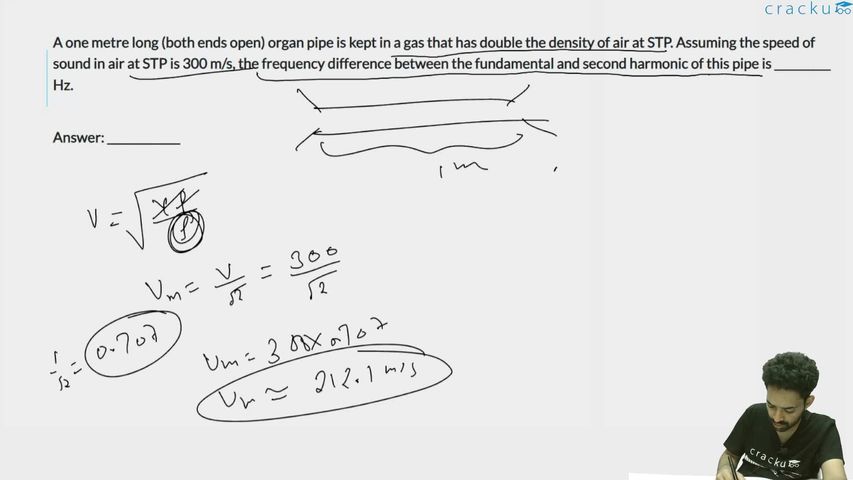
A one metre long (both ends open) organ pipe is kept in a gas that has double the density of air at STP. Assuming the speed of sound in air at STP is 300 m/s, the frequency difference between the fundamental and second harmonic of this pipe is __________ Hz.
Correct Answer: 106
We begin with the well-known formula for the speed of sound in an ideal gas, $$v=\sqrt{\dfrac{\gamma P}{\rho}}$$, where $$\gamma$$ is the ratio of specific heats, $$P$$ is the pressure and $$\rho$$ is the density. For two gases at the same pressure and temperature having the same $$\gamma$$, the speed of sound varies inversely as the square root of the density, so $$v\propto\dfrac1{\sqrt{\rho}}$$.
We are told that the given gas has double the density of air at STP. Hence, if the speed of sound in air is $$300\ \text{m s}^{-1}$$, then in the denser gas we have
$$v_{\text{gas}} = \dfrac{300}{\sqrt{2}}\ \text{m s}^{-1} = 300 \times \dfrac{1}{1.414}\ \text{m s}^{-1} = 212.1\ \text{m s}^{-1}\ (\text{approximately}).$$
Now consider the organ pipe. Because both ends are open, the standing-wave pattern has antinodes at each end. For an open-open pipe of length $$L$$, the allowed wavelengths are given by
$$\lambda_n = \dfrac{2L}{n},\qquad n = 1,2,3,\ldots$$
Therefore, the corresponding frequencies are
$$f_n = \dfrac{v}{\lambda_n} = \dfrac{v}{2L}\,n.$$
For the fundamental (first harmonic) we set $$n=1$$:
$$f_1 = \dfrac{v}{2L}.$$
For the second harmonic we set $$n=2$$:
$$f_2 = \dfrac{2v}{2L} = \dfrac{v}{L}.$$
The question asks for the difference between these two frequencies. Substituting the expressions we just obtained, we find
$$f_2 - f_1 = \dfrac{v}{L} - \dfrac{v}{2L} = \dfrac{v}{2L}.$$
The pipe length is given as $$L = 1\ \text{m}$$, so
$$f_2 - f_1 = \dfrac{v}{2(1)} = \dfrac{v}{2}.$$
Finally, insert the speed of sound in the gas, $$v = 212.1\ \text{m s}^{-1}$$:
$$f_2 - f_1 = \dfrac{212.1}{2}\ \text{Hz} \approx 106\ \text{Hz}.$$
Hence, the correct answer is Option 106 Hz.
Was this solution helpful?
Click on the Email ☝️ to Watch the Video Solution
Create a FREE account and get:
_1.webp)

Educational materials for JEE preparation

Ask our AI anything

AI can make mistakes. Please verify important information.
AI can make mistakes. Please verify important information.
