
Join Our JEE Preparation Group
Prep with like-minded aspirants; Get access to free daily tests and study material.
Sign in
Please select an account to continue using cracku.in
↓ →
Join Our JEE Preparation Group
Prep with like-minded aspirants; Get access to free daily tests and study material.
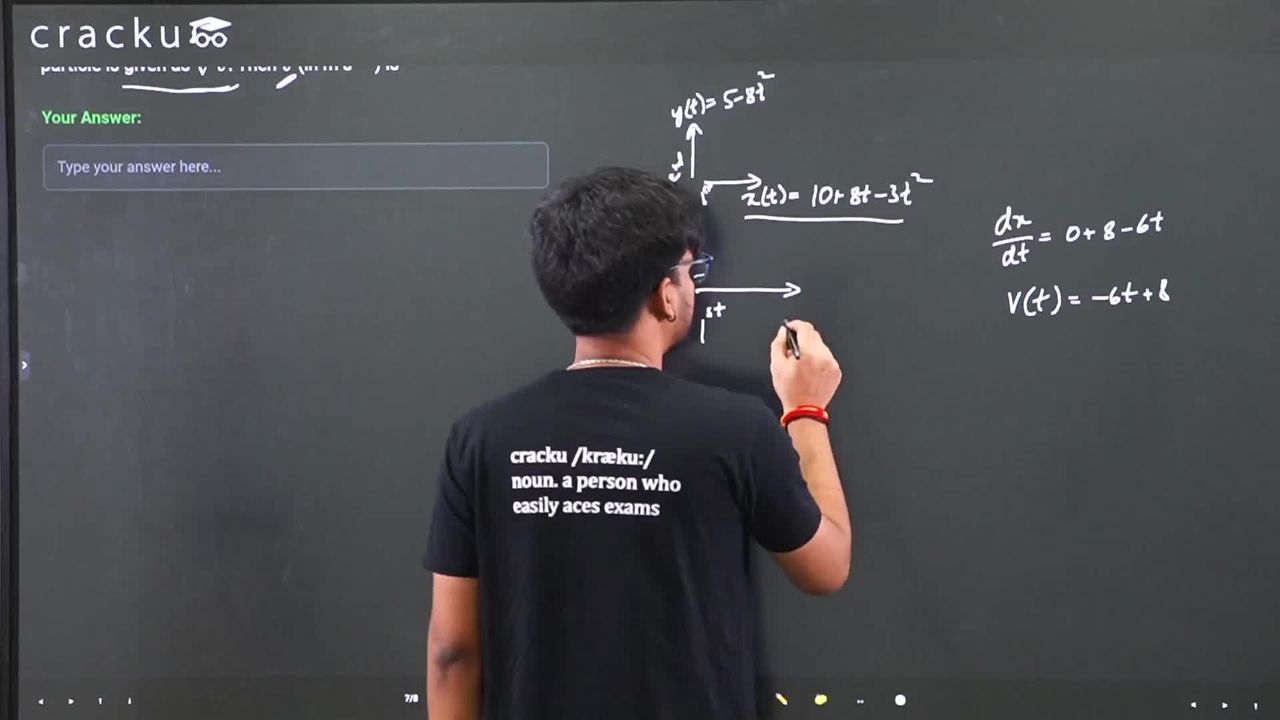
A particle is moving along the $$x$$-axis with its coordinate with time $$t$$ given by $$x(t) = 10 + 8t - 3t^2$$. Another particle is moving along the $$y$$-axis with its coordinate as a function of time given by $$y(t) = 5 - 8t^3$$. At $$t = 1$$ s, the speed of the second particle as measured in the frame of the first particle is given as $$\sqrt{v}$$. Then $$v$$ (in m s$$^{-1}$$) is
Correct Answer: 580
We begin by writing the position of each particle as a vector in the two-dimensional plane.
The first particle moves only along the $$x$$-axis, so its position vector at any instant $$t$$ is
$$\vec r_1(t)=x(t)\,\hat i+0\,\hat j=\bigl(10+8t-3t^{2}\bigr)\,\hat i.$$
The second particle moves only along the $$y$$-axis, hence its position vector is
$$\vec r_2(t)=0\,\hat i+y(t)\,\hat j=\bigl(5-8t^{3}\bigr)\,\hat j.$$
Velocity is obtained by differentiating the position with respect to time.
For the first particle we have
$$\vec v_1(t)=\frac{d\vec r_1}{dt}=\frac{d}{dt}\bigl(10+8t-3t^{2}\bigr)\hat i =(8-6t)\,\hat i.$$
For the second particle we have
$$\vec v_2(t)=\frac{d\vec r_2}{dt}=\frac{d}{dt}\bigl(5-8t^{3}\bigr)\hat j =(-24t^{2})\,\hat j.$$
We now substitute $$t=1\ \text{s}$$ to get the instantaneous velocities.
For the first particle:
$$\vec v_1(1)=\bigl(8-6\times1\bigr)\,\hat i=(2)\,\hat i\ \text{m s}^{-1}.$$
For the second particle:
$$\vec v_2(1)=\bigl(-24\times1^{2}\bigr)\,\hat j=(-24)\,\hat j\ \text{m s}^{-1}.$$
The velocity of the second particle as seen from the first particle is the relative velocity
$$\vec v_{\text{rel}}=\vec v_2-\vec v_1.$$
Writing the components explicitly, we have
$$\vec v_{\text{rel}}=(-2)\,\hat i+(-24)\,\hat j,$$ because along $$x$$, $$v_2$$ has no component and $$v_1$$ is $$+2\,$$, giving $$0-2=-2$$, while along $$y$$, $$v_1$$ has no component and $$v_2$$ is $$-24\,$$, giving $$-24-0=-24$$.
The speed is the magnitude of this vector. Using the two-dimensional magnitude formula $$|\vec v_{\text{rel}}|=\sqrt{(v_x)^2+(v_y)^2},$$ we obtain
$$|\vec v_{\text{rel}}|=\sqrt{(-2)^{2}+(-24)^{2}} =\sqrt{4+576} =\sqrt{580}\ \text{m s}^{-1}.$$
In the statement of the problem this speed is denoted as $$\sqrt{v}$$, so by comparison we identify
$$v=580.$$
Hence, the correct answer is Option C (580).
Was this solution helpful?
Click on the Email ☝️ to Watch the Video Solution
Create a FREE account and get:
_1.webp)

Educational materials for JEE preparation

Ask our AI anything

AI can make mistakes. Please verify important information.
AI can make mistakes. Please verify important information.
