
Join Our JEE Preparation Group
Prep with like-minded aspirants; Get access to free daily tests and study material.
Sign in
Please select an account to continue using cracku.in
↓ →
Join Our JEE Preparation Group
Prep with like-minded aspirants; Get access to free daily tests and study material.
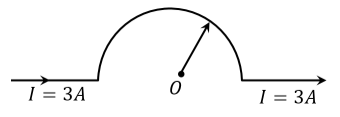
As shown in the figure, a long straight conductor with a semicircular arc of radius $$\frac{\pi}{10}$$ m is carrying a current $$I = 3A$$. The magnitude of the magnetic field at the center $$O$$ of the arc is: (The permeability of the vacuum $$= 4\pi \times 10^{-7} \text{ NA}^{-2}$$)
$$d\vec{B} = \frac{\mu_0}{4\pi} \frac{Id\vec{l} \times \hat{r}}{r^2}$$
For the straight sections shown in the figure, point $$O$$ lies on the axis of the conductor. This means the angle between the current element ($$d\vec{l}$$) and the position vector ($$\vec{r}$$) is either $$0^\circ$$ or $$180^\circ$$. Since $$\sin(0^\circ) = \sin(180^\circ) = 0$$, the magnetic field contribution from both straight sections is zero.
The magnitude of the magnetic field at the center of a circular arc of radius $$R$$ subtending an angle $$\theta$$ (in radians) is $$B = \frac{\mu_0 I}{4 \pi R} \theta$$
For a semicircle, the angle $$\theta = \pi$$ radians. $$B_{\text{arc}} = \frac{\mu_0 I}{4 \pi R} (\pi) = \frac{\mu_0 I}{4 R}$$
$$B = \frac{(4\pi \times 10^{-7}) \times 3}{4 \times \left( \frac{\pi}{10} \right)}$$
$$B = \frac{12\pi \times 10^{-7}}{\frac{4\pi}{10}} = \frac{12\pi \times 10 \times 10^{-7}}{4\pi}$$
$$B = 3 \times 10^{-6}\text{ T} = \mathbf{3\text{ }\mu\text{T}}$$
Was this solution helpful?
_1.webp)

Educational materials for JEE preparation

Ask our AI anything

AI can make mistakes. Please verify important information.
AI can make mistakes. Please verify important information.