
Join Our JEE Preparation Group
Prep with like-minded aspirants; Get access to free daily tests and study material.
Sign in
Please select an account to continue using cracku.in
↓ →
Join Our JEE Preparation Group
Prep with like-minded aspirants; Get access to free daily tests and study material.
In an experiment to find out the diameter of wire using screw gauge, the following observation were noted:
(a) Screw moves 0.5 mm on main scale in one complete rotation
(b) Total divisions on circular scale = 50
(c) Main scale reading is 2.5 mm
(d) 45th division of circular scale is in the pitch line
(e) Instrument has 0.03 mm negative error
Then the diameter of wire is:
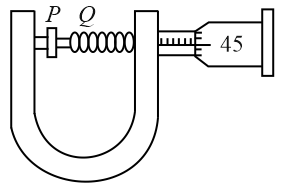
We need to determine the correct diameter of the wire using the observations recorded from the screw gauge experiment.
The total measurement from a screw gauge is calculated using the formula:
$$\text{Total Reading} = \text{Main Scale Reading (MSR)} + \text{Circular Scale Reading (CSR)} - \text{Zero Error}$$
The least count is the smallest distance the screw can measure accurately, which is defined as the pitch divided by the total number of divisions on the circular scale.
$$LC = \frac{\text{Pitch}}{\text{Total Circular Scale Divisions}} = \frac{0.5\text{ mm}}{50} = 0.01\text{ mm}$$
The circular scale reading is obtained by multiplying the coinciding division line on the pitch axis by the least count.
$$\text{CSR} = 45 \times LC = 45 \times 0.01\text{ mm} = 0.45\text{ mm}$$
The instrument is given to have a negative error:
When computing the true reading, a negative zero error must be subtracted, which mathematically amounts to adding its absolute magnitude to the observed reading.
Given the Main Scale Reading ($\text{MSR}$) is $$2.5\text{ mm}$$, we substitute all the values into our main formula:
$$\text{Diameter} = \text{MSR} + \text{CSR} - \text{Zero Error}$$
$$\text{Diameter} = 2.5\text{ mm} + 0.45\text{ mm} - (-0.03\text{ mm})$$
$$\text{Diameter} = 2.5\text{ mm} + 0.45\text{ mm} + 0.03\text{ mm} = 2.98\text{ mm}$$
Therefore, the correct diameter of the wire is 2.98 mm, which corresponds to Option C.
Was this solution helpful?
Click on the Email ☝️ to Watch the Video Solution
Create a FREE account and get:
_1.webp)

Educational materials for JEE preparation

Ask our AI anything

AI can make mistakes. Please verify important information.
AI can make mistakes. Please verify important information.
