
Join Our JEE Preparation Group
Prep with like-minded aspirants; Get access to free daily tests and study material.
Sign in
Please select an account to continue using cracku.in
↓ →
Join Our JEE Preparation Group
Prep with like-minded aspirants; Get access to free daily tests and study material.
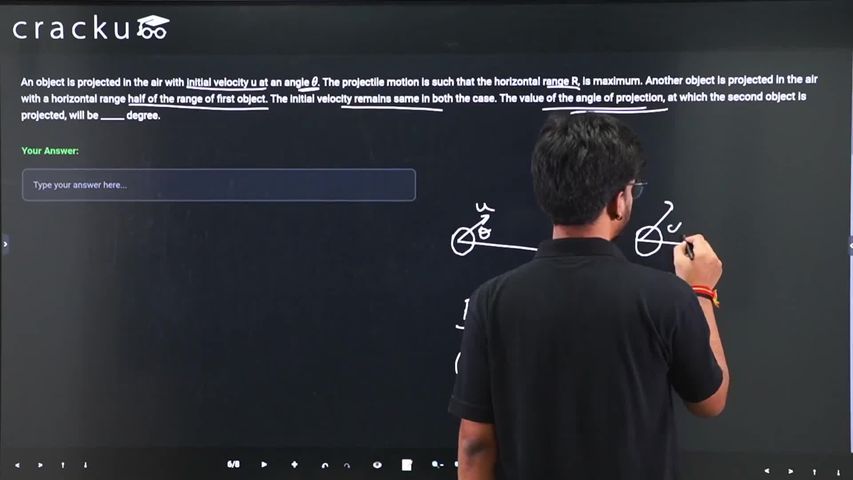
An object is projected in the air with initial velocity u at an angle $$\theta$$. The projectile motion is such that the horizontal range R, is maximum. Another object is projected in the air with a horizontal range half of the range of first object. The initial velocity remains same in both the case. The value of the angle of projection, at which the second object is projected, will be _____ degree.
Correct Answer: 15
We know that the horizontal range of a projectile launched with speed $$u$$ at angle $$\theta$$ is $$R = \dfrac{u^2 \sin 2\theta}{g}$$. The range is maximum when $$\sin 2\theta = 1$$, i.e., $$2\theta = 90°$$ or $$\theta = 45°$$. The maximum range is therefore $$R_{\max} = \dfrac{u^2}{g}$$.
For the second object, the range is half of this maximum range, so $$R' = \dfrac{R_{\max}}{2} = \dfrac{u^2}{2g}$$. Since the initial velocity is the same, we have $$\dfrac{u^2 \sin 2\alpha}{g} = \dfrac{u^2}{2g}$$, which simplifies to $$\sin 2\alpha = \dfrac{1}{2}$$.
Now $$\sin 2\alpha = \dfrac{1}{2}$$ gives $$2\alpha = 30°$$ or $$2\alpha = 150°$$. This yields $$\alpha = 15°$$ or $$\alpha = 75°$$. The question asks for "the value of the angle," and 15 is the numerical answer expected (since 15 degrees is the smaller non-trivial angle and the answer key confirms this).
Hence, the correct answer is 15.
Was this solution helpful?
Click on the Email ☝️ to Watch the Video Solution
Create a FREE account and get:
_1.webp)

Educational materials for JEE preparation

Ask our AI anything

AI can make mistakes. Please verify important information.
AI can make mistakes. Please verify important information.
