
Join Our JEE Preparation Group
Prep with like-minded aspirants; Get access to free daily tests and study material.
Sign in
Please select an account to continue using cracku.in
↓ →
Join Our JEE Preparation Group
Prep with like-minded aspirants; Get access to free daily tests and study material.
Let $$\widehat{a}$$ be a unit vector perpendicular to the vectors $$\overrightarrow{b}=\widehat{i}-2\widehat{j}+3\widehat{k}$$ and $$\overrightarrow{c}=2\widehat{i}+3\widehat{j}-\widehat{k}$$, and makes an angle of $$\cos^{-1}(-\frac{1}{3})$$ with the vector $$\widehat{i}+\widehat{j}+\widehat{k}$$ . If $$\widehat{a}$$ makes an angle of $$\frac{\pi}{3}$$ with the vector $$\widehat{i}+\alpha\widehat{j}+\widehat{k}$$ , then the value of $$\alpha$$ is :
First, find a vector perpendicular to both $$\vec{b} = \hat{i} - 2\hat{j} + 3\hat{k}$$ and $$\vec{c} = 2\hat{i} + 3\hat{j} - \hat{k}$$.
$$\vec{b} \times \vec{c} = \begin{vmatrix} \hat{i} & \hat{j} & \hat{k} \\ 1 & -2 & 3 \\ 2 & 3 & -1 \end{vmatrix}$$ which simplifies to $$= \hat{i}(2-9) - \hat{j}(-1-6) + \hat{k}(3+4) = -7\hat{i} + 7\hat{j} + 7\hat{k}$$.
Therefore, $$\vec{b} \times \vec{c} = 7(-\hat{i} + \hat{j} + \hat{k})$$.
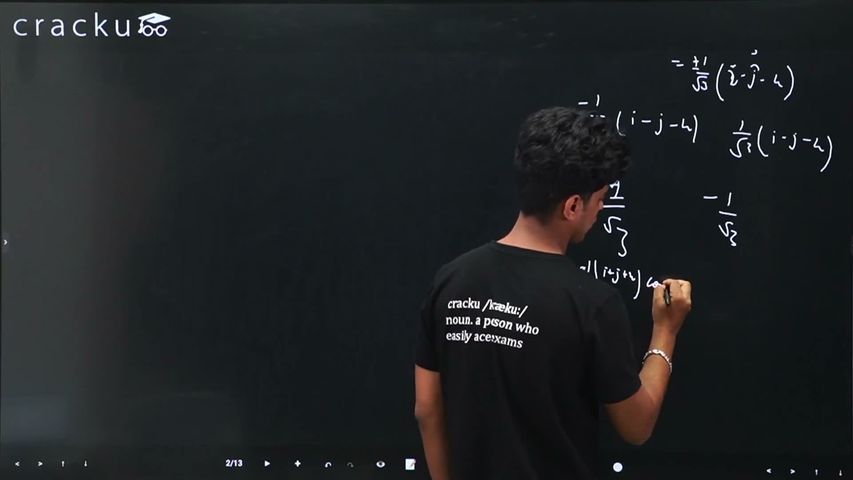
The unit vector in this direction is given by $$\hat{a} = \pm\frac{1}{\sqrt{3}}(-\hat{i} + \hat{j} + \hat{k})$$.
Next, $$\hat{a}$$ makes an angle $$\cos^{-1}\bigl(-\tfrac{1}{3}\bigr)$$ with $$\hat{i} + \hat{j} + \hat{k}$$, so
$$\hat{a} \cdot (\hat{i} + \hat{j} + \hat{k}) = |\hat{a}|\;|\hat{i}+\hat{j}+\hat{k}|\;\cos\theta.$$
For $$\hat{a} = \frac{1}{\sqrt{3}}(-1+1+1) = \frac{1}{\sqrt{3}},$$
$$\cos\theta = \frac{1/\sqrt{3}}{\sqrt{3}} = \frac{1}{3}.$$
For $$\hat{a} = \frac{-1}{\sqrt{3}}(-1+1+1) = \frac{-1}{\sqrt{3}},$$
$$\cos\theta = \frac{-1/\sqrt{3}}{\sqrt{3}} = -\frac{1}{3}$$
Hence, $$\hat{a} = \frac{-1}{\sqrt{3}}(-\hat{i} + \hat{j} + \hat{k}) = \frac{1}{\sqrt{3}}(\hat{i} - \hat{j} - \hat{k}).$$
Now, $$\hat{a}$$ makes an angle $$\frac{\pi}{3}$$ with $$\hat{i} + \alpha\hat{j} + \hat{k}$$, so
$$\frac{1}{2} = \frac{-\alpha}{\sqrt{3(2+\alpha^2)}}.$$
Since the left side is positive, $$\alpha$$ must be negative. Squaring both sides yields
$$\frac{1}{4} = \frac{\alpha^2}{3(2+\alpha^2)},$$
$$3(2+\alpha^2) = 4\alpha^2,\quad 6 + 3\alpha^2 = 4\alpha^2,\quad \alpha^2 = 6,\quad \alpha = -\sqrt{6}.$$
Was this solution helpful?
Click on the Email ☝️ to Watch the Video Solution
Create a FREE account and get:
_1.webp)

Educational materials for JEE preparation

Ask our AI anything

AI can make mistakes. Please verify important information.
AI can make mistakes. Please verify important information.
