
Join Our JEE Preparation Group
Prep with like-minded aspirants; Get access to free daily tests and study material.
Sign in
Please select an account to continue using cracku.in
↓ →
Join Our JEE Preparation Group
Prep with like-minded aspirants; Get access to free daily tests and study material.
Let $$f(x)=\int_{0}^{t}t(t^{2}-9t+20)dt$$, $$1 \le x \le 5$$. If the range of $$f$$ is $$[\alpha, \beta]$$, then $$4(\alpha + \beta)$$ equals :
We first evaluate the integral that defines the function.
Given $$f(x)=\int_{0}^{x} t\,(t^{2}-9t+20)\,dt$$ on $$1 \le x \le 5$$.
Simplify the integrand:
$$t\,(t^{2}-9t+20)=t^{3}-9t^{2}+20t.$$
Hence
$$f(x)=\int_{0}^{x} \left(t^{3}-9t^{2}+20t\right) dt.$$
Integrate term-by-term:
$$\int t^{3}dt=\frac{t^{4}}{4},\quad
\int (-9t^{2})dt=-3t^{3},\quad
\int 20t\,dt=10t^{2}.$$
Thus
$$f(x)=\left[\frac{t^{4}}{4}-3t^{3}+10t^{2}\right]_{0}^{x}
=\frac{x^{4}}{4}-3x^{3}+10x^{2}.$$
To find the range of $$f$$ on $$[1,5]$$ we examine its critical points.
Differentiate:
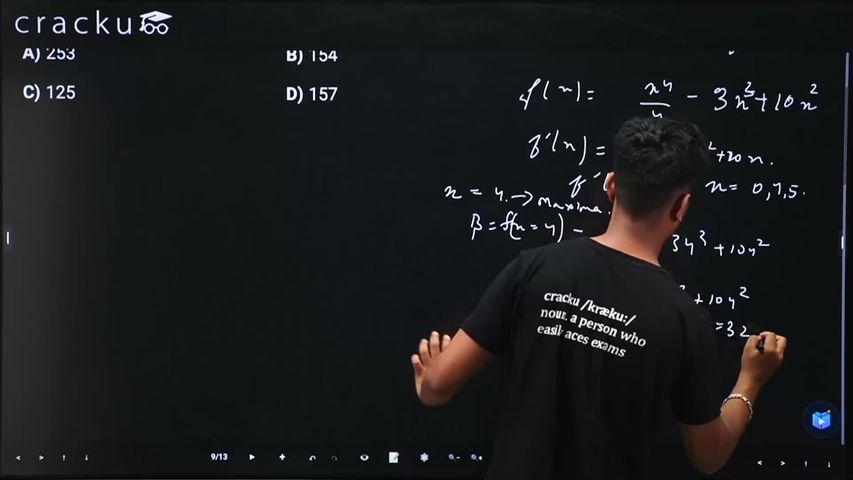
$$f'(x)=x^{3}-9x^{2}+20x.$$
Factor:
$$f'(x)=x\,(x^{2}-9x+20)=x\,(x-4)\,(x-5).$$
Critical points inside the interval come from $$f'(x)=0$$:
$$x=4,\;x=5$$ (note $$x=0$$ lies outside the given domain).
Sign chart of $$f'(x)$$ on $$[1,5]$$:
• For $$1\le x\lt 4$$, choose $$x=2$$: the factors are $$(+)\,(-)\,(-)\Rightarrow f'(x)\gt 0$$ (increasing).
• For $$4\lt x\lt 5$$, choose $$x=4.5$$: $$(+)\,(+)\,(-)\Rightarrow f'(x)\lt 0$$ (decreasing).
• Just beyond $$5$$ (not needed here) the derivative becomes positive again.
Therefore within $$[1,5]$$:
• $$f$$ increases up to $$x=4$$,
• attains a maximum at $$x=4$$,
• then decreases up to $$x=5$$.
Possible extrema on a closed interval are at critical points and endpoints. Compute $$f(x)$$ at these points:
At $$x=1$$:
$$f(1)=\frac{1^{4}}{4}-3(1)^{3}+10(1)^{2}
=\frac14-3+10
=\frac{29}{4}=7.25.$$
At $$x=4$$:
$$f(4)=\frac{4^{4}}{4}-3(4)^{3}+10(4)^{2}
=64-192+160
=32.$$
At $$x=5$$:
$$f(5)=\frac{5^{4}}{4}-3(5)^{3}+10(5)^{2
}
=\frac{625}{4}-375+250
=\frac{125}{4}=31.25.$$
Comparing these values:
$$f_{\text{min}} = f(1) = \frac{29}{4},\qquad
f_{\text{max}} = f(4) = 32.$$
Hence the range of $$f$$ is $$\left[\alpha,\beta\right]=\left[\frac{29}{4},\,32\right].$$
Compute $$4(\alpha+\beta)$$:
$$\alpha+\beta=\frac{29}{4}+32=\frac{29}{4}+\frac{128}{4}=\frac{157}{4},$$
so $$4(\alpha+\beta)=4\left(\frac{157}{4}\right)=157.$$
The required value is $$157$$, which matches Option D.
Was this solution helpful?
Click on the Email ☝️ to Watch the Video Solution
Create a FREE account and get:
_1.webp)

Educational materials for JEE preparation

Ask our AI anything

AI can make mistakes. Please verify important information.
AI can make mistakes. Please verify important information.
