
Join Our JEE Preparation Group
Prep with like-minded aspirants; Get access to free daily tests and study material.
Sign in
Please select an account to continue using cracku.in
↓ →
Join Our JEE Preparation Group
Prep with like-minded aspirants; Get access to free daily tests and study material.
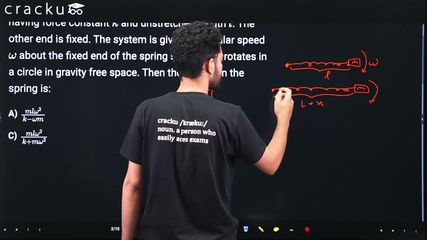
A particle of mass $$m$$ is fixed to one end of a light spring having force constant $$k$$ and unstretched length $$l$$. The other end is fixed. The system is given an angular speed $$\omega$$ about the fixed end of the spring such that it rotates in a circle in gravity free space. Then the stretch in the spring is:
Let the spring of natural length $$l$$ elongate by an amount $$x$$ when the system starts rotating. Thus the actual radial distance of the mass from the fixed support becomes $$r = l + x$$.
First we write the two physical relations that govern the situation.
1. Hooke’s law for a spring tells us that the magnitude of the tension (restoring force) in the spring equals the product of its force constant and its extension: $$T = kx$$.
2. For uniform circular motion the required centripetal force is provided entirely by this tension. The standard formula for centripetal force is $$F_{\text{c}} = m\omega^{2}r$$, where $$r$$ is the radius of the circular path.
Because the tension supplies the centripetal force, we equate the two expressions:
$$kx = m\omega^{2}r.$$
Now we substitute $$r = l + x$$ into this equality:
$$kx = m\omega^{2}(l + x).$$
Next, we expand the right-hand side to separate the terms:
$$kx = m\omega^{2}l + m\omega^{2}x.$$
To collect all the terms containing $$x$$ on the left side, we subtract $$m\omega^{2}x$$ from both sides:
$$kx - m\omega^{2}x = m\omega^{2}l.$$
We factor out $$x$$ from the left-hand side:
$$x\,(k - m\omega^{2}) = m\omega^{2}l.$$
Finally, to isolate $$x$$ we divide both sides by $$(k - m\omega^{2})$$, yielding
$$x = \frac{m\omega^{2}l}{k - m\omega^{2}}.$$
This fraction represents the stretch produced in the spring when the system rotates with angular speed $$\omega$$ in the absence of gravity.
Hence, the correct answer is Option B.
Was this solution helpful?
Click on the Email ☝️ to Watch the Video Solution
Create a FREE account and get:
_1.webp)

Educational materials for JEE preparation

Ask our AI anything

AI can make mistakes. Please verify important information.
AI can make mistakes. Please verify important information.
