
Join Our JEE Preparation Group
Prep with like-minded aspirants; Get access to free daily tests and study material.
Sign in
Please select an account to continue using cracku.in
↓ →
Join Our JEE Preparation Group
Prep with like-minded aspirants; Get access to free daily tests and study material.
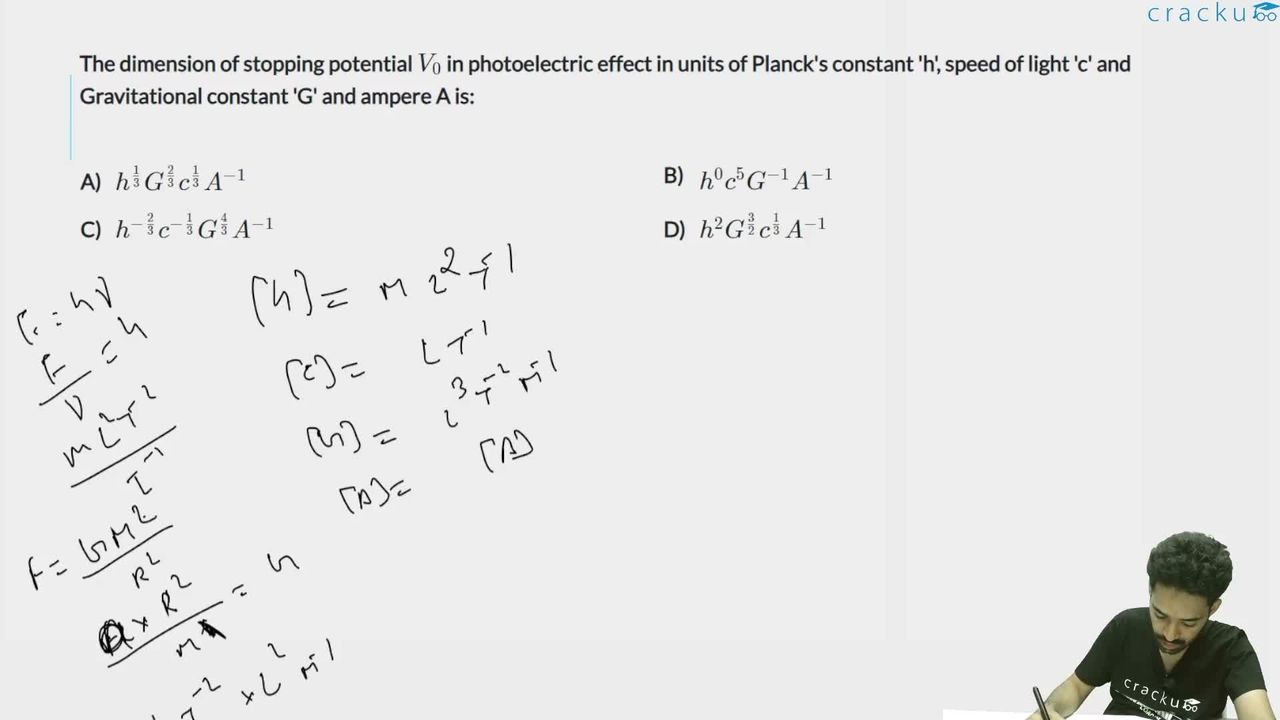
The dimension of stopping potential $$V_0$$ in photoelectric effect in units of Planck's constant 'h', speed of light 'c' and Gravitational constant 'G' and ampere A is:
We begin by recalling that the stopping potential $$V_0$$ is an electric potential difference (voltage). By definition, electric potential is work per unit charge, so in fundamental dimensions it is written as
$$[V_0]=[ \text{energy} ]\, [\text{charge}]^{-1}=M\,L^{2}\,T^{-3}\,I^{-1}.$$
We have to reproduce this combination using the four given reference quantities: Planck’s constant $$h,$$ the speed of light $$c,$$ the universal gravitational constant $$G,$$ and the ampere $$A$$ (which already carries the current dimension). First we write down their dimensional formulas.
1. Planck’s constant represents angular momentum or energy × time, hence $$[h]=M\,L^{2}\,T^{-1}.$$
2. The speed of light is simply a velocity, therefore $$[c]=L\,T^{-1}.$$
3. The gravitational constant follows from Newton’s law $$F=\dfrac{Gm_1m_2}{r^{2}}.$$ Solving, we find $$[G]=M^{-1}\,L^{3}\,T^{-2}.$$
4. The ampere already carries the unit of current, so $$[A]=I.$$
Next, we assume that the required combination is $$h^{\,x}\,c^{\,y}\,G^{\,z}\,A^{\,w},$$ with unknown exponents $$x,\;y,\;z,\;w$$ to be determined. Multiplying the dimensions of each factor, we obtain the overall dimensional product:
$$\begin{aligned} [h^{\,x}] &= M^{x}\,L^{2x}\,T^{-x},\\[2pt] [c^{\,y}] &= L^{y}\,T^{-y},\\[2pt] [G^{\,z}] &= M^{-z}\,L^{3z}\,T^{-2z},\\[2pt] [A^{\,w}] &= I^{\,w}. \end{aligned}$$
Combining the corresponding powers of each fundamental dimension gives
$$M^{\,x-z}\,L^{\,2x+y+3z}\,T^{\,(-x-y-2z)}\,I^{\,w}.$$
We now equate the exponents of each basic dimension with those required for a potential $$M^{1}\,L^{2}\,T^{-3}\,I^{-1}.$$ Hence we write the system of equations
$$\begin{aligned} \text{Mass:}\;&x-z &=& 1,\\ \text{Length:}\;&2x+y+3z &=& 2,\\ \text{Time:}\;&-x-y-2z &=& -3,\\ \text{Current:}\;&w &=& -1. \end{aligned}$$
From the mass equation $$x-z=1$$ we find $$z=x-1.$$
Substituting this into the length equation,
$$2x+y+3(x-1)=2 \;\Longrightarrow\; 5x+y-3=2 \;\Longrightarrow\; 5x+y=5,$$ which rearranges to $$y=5-5x.$$
Now we use the time equation. Replacing $$y$$ and $$z$$ with the expressions just obtained,
$$-x-\bigl(5-5x\bigr)-2\,(x-1)=-3.$$
Simplifying step by step,
$$-x-5+5x-2x+2=-3,$$ $$(-x+5x-2x)=2x,\qquad(-5+2)=-3,$$ so
$$2x-3=-3.$$
Adding 3 to both sides gives $$2x=0\;\Longrightarrow\;x=0.$$
Immediately, $$z=x-1=0-1=-1,$$ and $$y=5-5x=5-0=5.$$
Finally, from the current equation we already have $$w=-1.$$
Collecting all exponents, the required dimensional combination is
$$h^{0}\,c^{5}\,G^{-1}\,A^{-1}.$$
Because $$h^{0}=1,$$ this result exactly matches Option B.
Hence, the correct answer is Option B.
Was this solution helpful?
Click on the Email ☝️ to Watch the Video Solution
Create a FREE account and get:
_1.webp)

Educational materials for JEE preparation

Ask our AI anything

AI can make mistakes. Please verify important information.
AI can make mistakes. Please verify important information.
