
Join Our JEE Preparation Group
Prep with like-minded aspirants; Get access to free daily tests and study material.
Sign in
Please select an account to continue using cracku.in
↓ →
Join Our JEE Preparation Group
Prep with like-minded aspirants; Get access to free daily tests and study material.
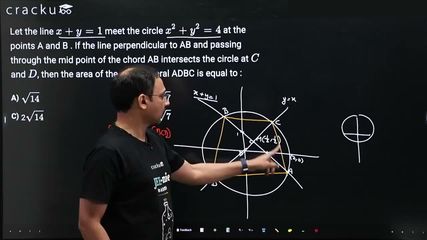
Let the line $$x + y = 1$$ meet the circle $$x^{2}+y^{2}=4$$ at the points A and B . If the line perpendicular to AB and passing through the mid point of the chord AB intersects the circle at $$C$$ and $$D$$, then the area of the quadrilateral ADBC is equal to :
We have the circle $$x^2 + y^2 = 4$$ (centre O at origin, radius $$r = 2$$) and the chord $$x + y = 1$$.
The perpendicular from the centre (0, 0) to the line $$x + y = 1$$ meets the chord at its midpoint M.
Distance from origin to the line $$x + y - 1 = 0$$:
$$d = \frac{|0 + 0 - 1|}{\sqrt{1^2 + 1^2}} = \frac{1}{\sqrt{2}}$$
The midpoint M lies on $$x + y = 1$$ and on the line $$y = x$$ (perpendicular from origin to $$x + y = 1$$ has slope 1, since the chord has slope -1). So $$2x = 1$$, giving $$M = \left(\frac{1}{2}, \frac{1}{2}\right)$$.
Half-length of AB: $$\sqrt{r^2 - d^2} = \sqrt{4 - \frac{1}{2}} = \sqrt{\frac{7}{2}}$$.
So $$AB = 2\sqrt{\frac{7}{2}} = \sqrt{14}$$.
CD is the chord along the line $$y = x$$ (the perpendicular bisector of AB passing through M). This line passes through the centre O(0,0), so CD is a diameter.
Therefore $$CD = 2r = 4$$.
The quadrilateral ADBC has diagonals AB and CD. These two chords are perpendicular to each other (AB has slope -1, CD has slope 1), and they intersect at M.
For a quadrilateral whose diagonals are perpendicular and intersect at a point, the area is:
$$\text{Area} = \frac{1}{2} \times d_1 \times d_2$$
where $$d_1$$ and $$d_2$$ are the full diagonal lengths.
$$\text{Area} = \frac{1}{2} \times \sqrt{14} \times 4 = 2\sqrt{14}$$
The answer is $$\boxed{2\sqrt{14}}$$, which corresponds to Option 3.
Was this solution helpful?
Click on the Email ☝️ to Watch the Video Solution
Create a FREE account and get:
_1.webp)

Educational materials for JEE preparation

Ask our AI anything

AI can make mistakes. Please verify important information.
AI can make mistakes. Please verify important information.
