
Join Our JEE Preparation Group
Prep with like-minded aspirants; Get access to free daily tests and study material.
Sign in
Please select an account to continue using cracku.in
↓ →
Join Our JEE Preparation Group
Prep with like-minded aspirants; Get access to free daily tests and study material.
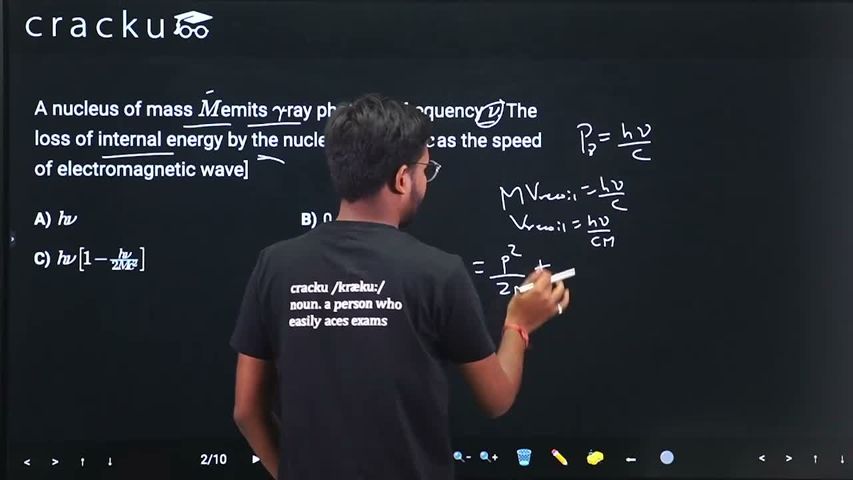
A nucleus of mass $$M$$ emits $$\gamma$$-ray photon of frequency $$\nu$$. The loss of internal energy by the nucleus is: [Take $$c$$ as the speed of electromagnetic wave]
When a nucleus of mass $$M$$ emits a $$\gamma$$-ray photon of frequency $$\nu$$, both energy and momentum must be conserved. The photon carries momentum $$p_{photon} = \frac{h\nu}{c}$$, so by conservation of momentum the nucleus recoils with the same magnitude of momentum: $$Mv_{recoil} = \frac{h\nu}{c}$$.
The recoil kinetic energy of the nucleus is $$K_{recoil} = \frac{(Mv_{recoil})^2}{2M} = \frac{(h\nu/c)^2}{2M} = \frac{(h\nu)^2}{2Mc^2}$$.
By conservation of energy, the loss of internal energy of the nucleus equals the energy of the photon plus the recoil kinetic energy:
$$\Delta E = h\nu + \frac{(h\nu)^2}{2Mc^2} = h\nu\left(1 + \frac{h\nu}{2Mc^2}\right)$$
Was this solution helpful?
Click on the Email ☝️ to Watch the Video Solution
Create a FREE account and get:
_1.webp)

Educational materials for JEE preparation

Ask our AI anything

AI can make mistakes. Please verify important information.
AI can make mistakes. Please verify important information.


