
Join Our JEE Preparation Group
Prep with like-minded aspirants; Get access to free daily tests and study material.
Sign in
Please select an account to continue using cracku.in
↓ →
Join Our JEE Preparation Group
Prep with like-minded aspirants; Get access to free daily tests and study material.
A radioactive material decays by simultaneous emissions of two particles with half lives of 1400 years and 700 years, respectively. What will be the time after the which one third of the material remains? (Take ln 3 = 1.1)
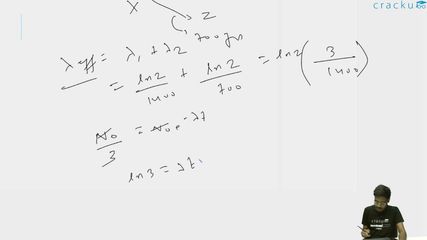
When a radioactive material undergoes simultaneous decay by two processes with half-lives $$T_1 = 1400$$ years and $$T_2 = 700$$ years, the effective decay constant is $$\lambda = \lambda_1 + \lambda_2 = \frac{\ln 2}{T_1} + \frac{\ln 2}{T_2}$$.
$$\lambda = \ln 2\left(\frac{1}{1400} + \frac{1}{700}\right) = \ln 2 \cdot \frac{1+2}{1400} = \frac{3\ln 2}{1400}$$
For one-third of the material to remain: $$N = \frac{N_0}{3} = N_0 e^{-\lambda t}$$, so $$\lambda t = \ln 3$$.
$$t = \frac{\ln 3}{\lambda} = \frac{\ln 3 \times 1400}{3\ln 2} = \frac{1.1 \times 1400}{3 \times 0.693} = \frac{1540}{2.079} \approx 741 \approx 740$$ years.
Was this solution helpful?
Click on the Email ☝️ to Watch the Video Solution
Create a FREE account and get:
_1.webp)

Educational materials for JEE preparation

Ask our AI anything

AI can make mistakes. Please verify important information.
AI can make mistakes. Please verify important information.


