
Join Our JEE Preparation Group
Prep with like-minded aspirants; Get access to free daily tests and study material.
Sign in
Please select an account to continue using cracku.in
↓ →
Join Our JEE Preparation Group
Prep with like-minded aspirants; Get access to free daily tests and study material.
$$\text{For some } a,b,\text{ let }f(x)=\left|\begin{matrix}a+\dfrac{\sin x}{x} & 1 & b \\a & 1+\dfrac{\sin x}{x} & b \\a & 1 & b+\dfrac{\sin x}{x}\end{matrix}\right|,x\neq 0,\lim_{x\to 0} f(x)=\lambda+\mu a+\nu b,\text{ Then } (\lambda+\mu+\nu)^2 \text{ is equal to:}$$
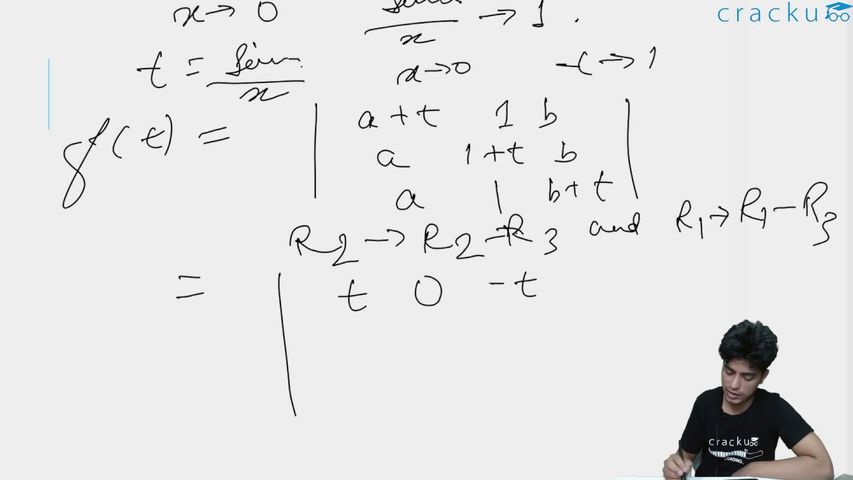
Let $$t=\frac{\sin x}{x}\,,$$ so that $$\displaystyle\lim_{x\to 0}t=1$$ because $$\frac{\sin x}{x}\to 1$$ as $$x\to 0$$.
With this notation the determinant becomes
$$f(x)=\left|\begin{matrix}a+t & 1 & b\\ a & 1+t & b\\ a & 1 & b+t\end{matrix}\right|.$$
Perform the row operation $$R_1\rightarrow R_1-R_2$$ (subtract the second row from the first):
$$f(x)=\left|\begin{matrix}t & -t & 0\\ a & 1+t & b\\ a & 1 & b+t\end{matrix}\right|.$$
Factor out $$t$$ from the first row:
$$f(x)=t\;\left|\begin{matrix}1 & -1 & 0\\ a & 1+t & b\\ a & 1 & b+t\end{matrix}\right|.$$
Call the remaining determinant $$D(t)$$, i.e.
$$D(t)=\left|\begin{matrix}1 & -1 & 0\\ a & 1+t & b\\ a & 1 & b+t\end{matrix}\right|.$$
Expand $$D(t)$$ along the first row:
$$\begin{aligned}
D(t)=&\;1\;\left|\begin{matrix}1+t & b\\ 1 & b+t\end{matrix}\right|
\;-\;(-1)\;\left|\begin{matrix}a & b\\ a & b+t\end{matrix}\right|
\;+\;0\\[4pt]
=&\;(1+t)(b+t)-b + a\,t.
\end{aligned}$$
Simplify the expression:
$$(1+t)(b+t)-b = (1+t)(b+t)-b = (1+t)(b+t)-b.$$
Therefore
$$D(t)=(1+t)(b+t)-b+a\,t.$$
Now take the limit as $$x\to 0$$, i.e. $$t\to 1$$:
$$\begin{aligned}
\lim_{x\to 0}f(x)
&=\lim_{t\to 1}\;t\,D(t)\\
&=1\;\bigl[(1+1)(b+1)-b+a\cdot 1\bigr]\\
&=(2)(b+1)-b+a\\
&=2b+2-b+a\\
&=a+b+2.
\end{aligned}$$
Hence
$$\lambda+\mu a+\nu b=a+b+2,$$
so $$\lambda=2,\;\mu=1,\;\nu=1.$$
The required value is
$$(\lambda+\mu+\nu)^2=(2+1+1)^2=4^2=16.$$
Therefore, the correct option is Option A (16).
Was this solution helpful?
Click on the Email ☝️ to Watch the Video Solution
Create a FREE account and get:
_1.webp)

Educational materials for JEE preparation

Ask our AI anything

AI can make mistakes. Please verify important information.
AI can make mistakes. Please verify important information.
