
Join Our JEE Preparation Group
Prep with like-minded aspirants; Get access to free daily tests and study material.
Sign in
Please select an account to continue using cracku.in
↓ →
Join Our JEE Preparation Group
Prep with like-minded aspirants; Get access to free daily tests and study material.
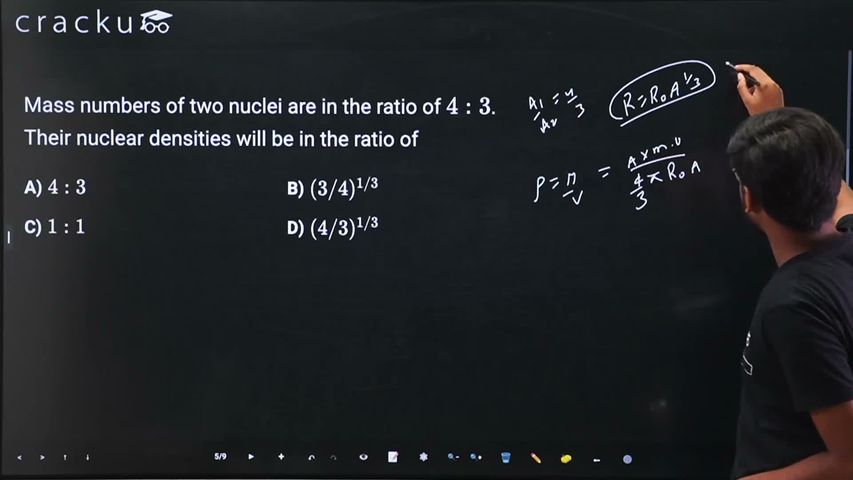
Mass numbers of two nuclei are in the ratio of $$4:3$$. Their nuclear densities will be in the ratio of
Two nuclei have mass numbers in the ratio $$4:3$$. We need to find the ratio of their nuclear densities.
Initially, the radius of a nucleus with mass number $$A$$ is given by the formula $$R = R_0 A^{1/3}$$ where $$R_0 \approx 1.2 \text{ fm}$$ is a constant.
Since the volume of a spherical nucleus depends on its radius, we write $$V = \dfrac{4}{3}\pi R^3 = \dfrac{4}{3}\pi R_0^3 A$$.
Furthermore, noting that the mass of a nucleus is approximately $$m = A \times m_u$$ (where $$m_u$$ is the atomic mass unit), we can express nuclear density as $$\rho = \dfrac{m}{V} = \dfrac{A \cdot m_u}{\dfrac{4}{3}\pi R_0^3 A} = \dfrac{m_u}{\dfrac{4}{3}\pi R_0^3}$$.
This observation shows that the mass number $$A$$ cancels out, implying nuclear density is independent of mass number. In fact, it is approximately the same for all nuclei: $$\rho \approx 2.3 \times 10^{17} \text{ kg m}^{-3}$$.
Therefore, the ratio of the nuclear densities of the two nuclei is $$1:1$$, corresponding to Option C.
Was this solution helpful?
Click on the Email ☝️ to Watch the Video Solution
Create a FREE account and get:
_1.webp)

Educational materials for JEE preparation

Ask our AI anything

AI can make mistakes. Please verify important information.
AI can make mistakes. Please verify important information.
