
Join Our JEE Preparation Group
Prep with like-minded aspirants; Get access to free daily tests and study material.
Sign in
Please select an account to continue using cracku.in
↓ →
Join Our JEE Preparation Group
Prep with like-minded aspirants; Get access to free daily tests and study material.
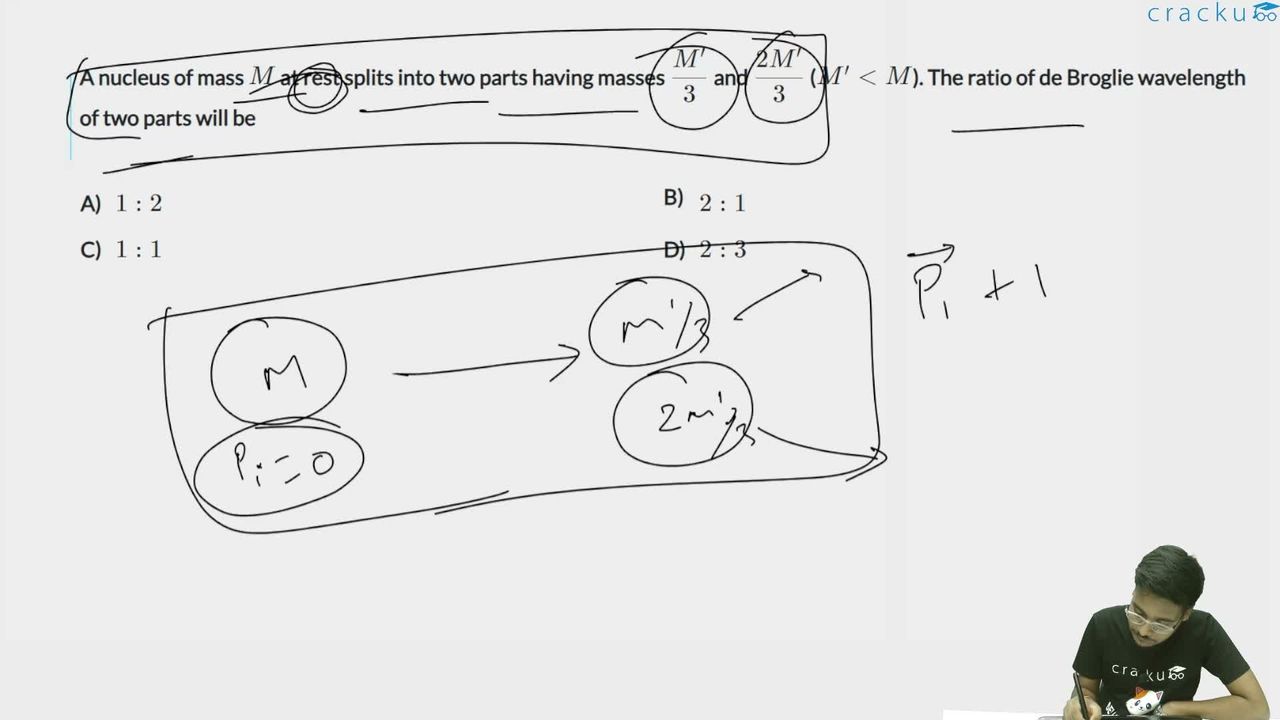
A nucleus of mass $$M$$ at rest splits into two parts having masses $$\dfrac{M'}{3}$$ and $$\dfrac{2M'}{3}$$ ($$M' < M$$). The ratio of de Broglie wavelength of two parts will be
A nucleus of mass $$M$$ at rest splits into two parts of masses $$\dfrac{M'}{3}$$ and $$\dfrac{2M'}{3}$$ (where $$M' < M$$), and we need to find the ratio of their de Broglie wavelengths.
Since the nucleus is initially at rest, conservation of linear momentum implies $$\vec{p}_1 + \vec{p}_2 = 0$$, leading to $$|\vec{p}_1| = |\vec{p}_2| = p$$, which means both fragments have the same magnitude of momentum.
The de Broglie wavelength is given by $$\lambda = \dfrac{h}{p}$$, where $$h$$ is Planck's constant and $$p$$ is the momentum of the particle.
Substituting the common momentum into the expressions for the two fragments yields $$\lambda_1 = \dfrac{h}{p}$$ and $$\lambda_2 = \dfrac{h}{p}$$, which gives $$\dfrac{\lambda_1}{\lambda_2} = \dfrac{h/p}{h/p} = 1$$.
Therefore, $$\lambda_1 : \lambda_2 = 1 : 1$$.
The correct answer is Option C: $$1:1$$.
Was this solution helpful?
Click on the Email ☝️ to Watch the Video Solution
Create a FREE account and get:
_1.webp)

Educational materials for JEE preparation

Ask our AI anything

AI can make mistakes. Please verify important information.
AI can make mistakes. Please verify important information.
