
Join Our JEE Preparation Group
Prep with like-minded aspirants; Get access to free daily tests and study material.
Sign in
Please select an account to continue using cracku.in
↓ →
Join Our JEE Preparation Group
Prep with like-minded aspirants; Get access to free daily tests and study material.
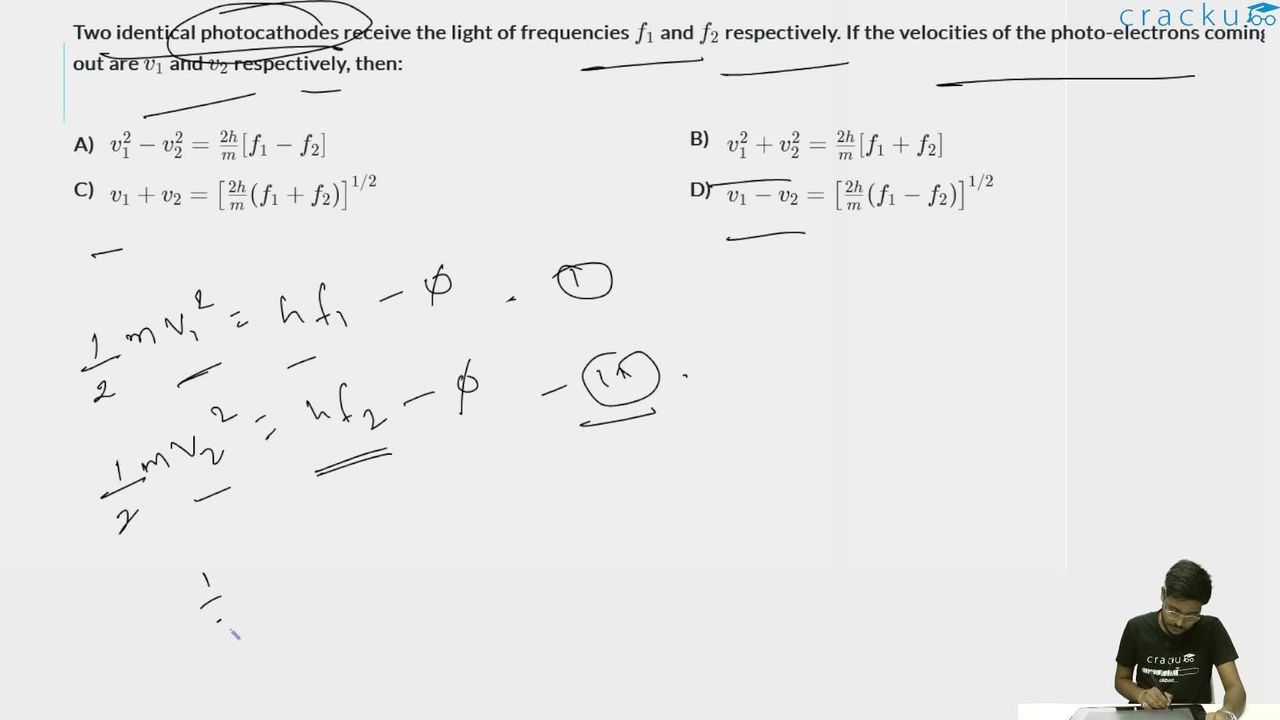
Two identical photocathodes receive the light of frequencies $$f_1$$ and $$f_2$$ respectively. If the velocities of the photo-electrons coming out are $$v_1$$ and $$v_2$$ respectively, then:
By Einstein's photoelectric equation, the maximum kinetic energy of a photoelectron is $$\frac{1}{2}mv^2 = hf - \phi$$, where $$\phi$$ is the work function of the photocathode.
For the first photocathode: $$\frac{1}{2}mv_1^2 = hf_1 - \phi$$. For the second photocathode (identical, so same $$\phi$$): $$\frac{1}{2}mv_2^2 = hf_2 - \phi$$.
Subtracting the second equation from the first: $$\frac{1}{2}m(v_1^2 - v_2^2) = h(f_1 - f_2)$$, which gives $$v_1^2 - v_2^2 = \frac{2h}{m}(f_1 - f_2)$$.
Was this solution helpful?
Click on the Email ☝️ to Watch the Video Solution
Create a FREE account and get:
_1.webp)

Educational materials for JEE preparation

Ask our AI anything

AI can make mistakes. Please verify important information.
AI can make mistakes. Please verify important information.


