
Join Our JEE Preparation Group
Prep with like-minded aspirants; Get access to free daily tests and study material.
Sign in
Please select an account to continue using cracku.in
↓ →
Join Our JEE Preparation Group
Prep with like-minded aspirants; Get access to free daily tests and study material.
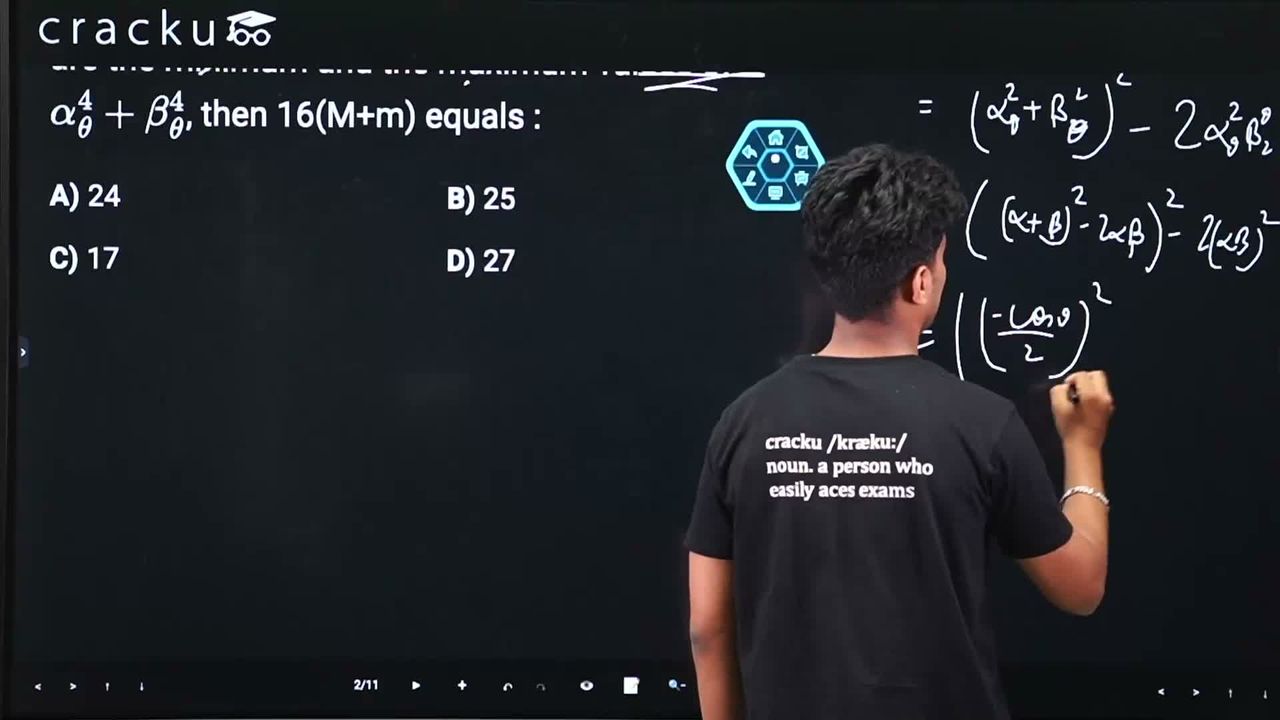
Let $$\alpha_{\theta}$$ and $$\beta_{\theta}$$ be the distinct roots of $$2x^{2}+(\cos \theta)x-1=0,\theta \in (0,2\pi)$$. If m and M are the minimum and the maximum values of $$\alpha_{\theta}^{4}+\beta_{\theta}^{4}$$, then 16(M+m) equals :
$$\alpha_\theta + \beta_\theta = -\frac{\cos\theta}{2}$$ and $$\alpha_\theta\,\beta_\theta = -\frac{1}{2}$$
$$\alpha_\theta^2 + \beta_\theta^2 = (\alpha_\theta + \beta_\theta)^2 - 2\alpha_\theta\beta_\theta = \frac{\cos^2\theta}{4} + 1$$.
$$\alpha_\theta^4 + \beta_\theta^4 = (\alpha_\theta^2 + \beta_\theta^2)^2 - 2(\alpha_\theta\beta_\theta)^2 = \Bigl(\frac{\cos^2\theta}{4} + 1\Bigr)^2 - 2\cdot\frac{1}{4} = \frac{\cos^4\theta}{16} + \frac{\cos^2\theta}{2} + \frac{1}{2}$$.
Setting $$t = \cos^2\theta$$ with $$t\in[0,1]$$ leads to the function $$f(t) = \frac{t^2}{16} + \frac{t}{2} + \frac{1}{2}$$ whose derivative $$f'(t) = \frac{t}{8} + \frac{1}{2}$$ is strictly positive on $$[0,1]$$, so $$f$$ is increasing.
Therefore the minimum occurs at $$t=0$$ giving $$m = f(0) = \frac{1}{2}$$ and the maximum occurs at $$t=1$$ giving $$M = f(1) = \frac{1}{16} + \frac{1}{2} + \frac{1}{2} = \frac{17}{16}$$.
Hence $$16(M + m) = 16\Bigl(\frac{17}{16} + \frac{1}{2}\Bigr) = 17 + 8 = 25$$, so the final answer is 25.
Was this solution helpful?
Click on the Email ☝️ to Watch the Video Solution
Create a FREE account and get:
_1.webp)

Educational materials for JEE preparation

Ask our AI anything

AI can make mistakes. Please verify important information.
AI can make mistakes. Please verify important information.
