
Join Our JEE Preparation Group
Prep with like-minded aspirants; Get access to free daily tests and study material.
Sign in
Please select an account to continue using cracku.in
↓ →
Join Our JEE Preparation Group
Prep with like-minded aspirants; Get access to free daily tests and study material.
If x = f(y) is the solution of the differential equation $$\left(1+y^{2}\right)+\left(x-2e^{\tan^{-1}y}\right)\frac{dy}{dx}=0,y \in (-\frac{\pi}{2},\frac{\pi}{2})$$ with f(0) = 1, then $$f(\frac{1}{\sqrt{3}})$$ is equal to :
$$ (1 + y^2) + \left(x - 2e^{\tan^{-1}y}\right)\frac{dy}{dx} = 0 $$.
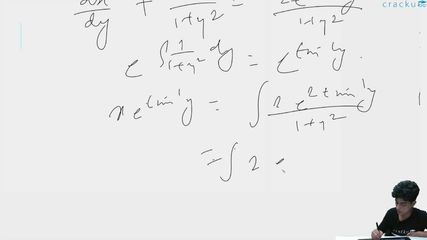
$$ \frac{dx}{dy} + \frac{x}{1 + y^2} = \frac{2e^{\tan^{-1}y}}{1 + y^2} $$
To solve it, we compute the integrating factor $$ \mathrm{I.F.} = e^{\int \frac{1}{1+y^2}\,dy} = e^{\tan^{-1}y} $$.
Multiplying both sides by this integrating factor and integrating yields $$ x\,e^{\tan^{-1}y} = \int \frac{2e^{2\tan^{-1}y}}{1 + y^2}\,dy $$.
With the substitution $$ t = \tan^{-1}y $$ so that $$ dt = \frac{dy}{1+y^2} $$, the integral becomes $$ \int 2e^{2t}\,dt = e^{2t} + C = e^{2\tan^{-1}y} + C $$. Hence $$ x\,e^{\tan^{-1}y} = e^{2\tan^{-1}y} + C $$.
Applying the initial condition $$ f(0) = 1 $$ (so $$ x = 1 $$ when $$ y = 0 $$) gives $$ 1 \cdot e^{0} = e^{0} + C $$, which implies $$ C = 0 $$. Therefore, we obtain $$ x\,e^{\tan^{-1}y} = e^{2\tan^{-1}y} $$ and hence $$ x = e^{\tan^{-1}y} $$.
Finally, evaluating at $$ y = \tfrac{1}{\sqrt{3}} $$ yields $$ f\bigl(\tfrac{1}{\sqrt{3}}\bigr) = e^{\tan^{-1}(\tfrac{1}{\sqrt{3}})} = e^{\pi/6} $$.
Was this solution helpful?
Click on the Email ☝️ to Watch the Video Solution
Create a FREE account and get:
_1.webp)

Educational materials for JEE preparation

Ask our AI anything

AI can make mistakes. Please verify important information.
AI can make mistakes. Please verify important information.
